
Mechanism of Pegloticase
How PEGylated Recombinant Uricase Converts Uric Acid into Allantoin in Advanced Gout Research
Abstract
Pegloticase is a PEGylated recombinant uricase designed to address the fundamental biochemical defect that underlies human hyperuricemia. Unlike most mammals, humans do not express functional uricase and therefore cannot enzymatically convert uric acid into the more soluble metabolite allantoin. Pegloticase restores this missing pathway through exogenous enzyme replacement, enabling rapid urate degradation and enhanced clearance.
This article explains the mechanism of pegloticase from evolutionary background to catalytic chemistry, structural design, PEGylation strategy, and translational research relevance. Special emphasis is placed on its role as an extrarenal urate-lowering approach and as a valuable reagent for studies involving gout, purine metabolism, cardiovascular biology, and biologic drug engineering.
pegloticase mechanism, recombinant uricase function, uric acid metabolism pathway, PEGylated biologics, advanced gout therapy, Pegloticase, Recombinant Uricase
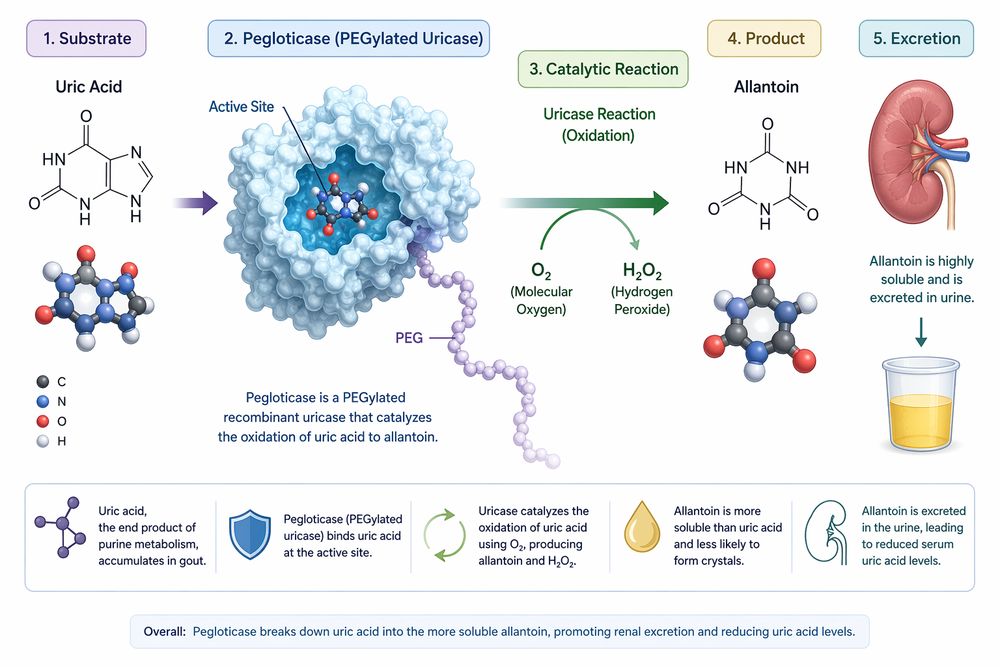
Fig 1. Overview of Pegloticase mechanism from uric acid oxidation to allantoin formation
1. Introduction to Hyperuricemia and Gout
Gout is one of the most common inflammatory arthritides and is driven by sustained hyperuricemia, defined as serum uric acid levels above the approximate solubility threshold of 6.8 mg/dL under physiological conditions. When urate remains above this threshold, monosodium urate crystals can deposit in joints and soft tissues, triggering acute inflammation, pain, erythema, and reduced mobility.
The clinical burden of gout extends beyond flares. In advanced disease, chronic tophaceous gout can lead to visible nodules, structural joint damage, and long-term disability. Although xanthine oxidase inhibitors such as allopurinol and febuxostat reduce uric acid production, some patients fail to reach target serum urate levels. This unmet need has driven interest in enzyme-based urate-lowering therapies, especially Pegloticase, Recombinant Uricase.
1.1 Evolutionary Loss of Uricase in Humans
Humans and great apes lost functional uricase during evolution because of inactivating mutations in the uricase gene (UOX). As a result, humans cannot oxidize uric acid to allantoin endogenously. While this loss may once have provided selective advantages, in the modern setting it creates a strong predisposition to hyperuricemia under conditions of high purine intake, fructose exposure, alcohol consumption, or impaired renal clearance.
Pegloticase effectively compensates for this evolutionary deficiency by reintroducing uricase activity through recombinant biotechnology. Rather than only suppressing uric acid synthesis, it restores the missing metabolic conversion step.
2. Enzymatic Conversion of Uric Acid to Allantoin
2.1 Core Catalytic Reaction
The key action of pegloticase is the oxidation of uric acid into 5-hydroxyisourate (5-HIU), with hydrogen peroxide generated as a byproduct. In species with a complete downstream pathway, 5-HIU is further processed to OHCU and then to stereospecific allantoin. Humans do not possess functional 5-HIU hydrolase or OHCU decarboxylase, so after recombinant uricase administration, 5-HIU proceeds through non-enzymatic conversion steps before ultimately forming allantoin.
Because allantoin is substantially more soluble than uric acid, this transformation accelerates elimination and lowers the urate burden that drives crystal deposition. Pegloticase is therefore distinct from standard urate-lowering drugs because it removes uric acid enzymatically rather than simply limiting its synthesis.
2.2 Biochemical Pathway of Uric Acid Oxidation
| Step | Enzyme / Process | Substrate | Product | Key Characteristics |
|---|---|---|---|---|
| 1 | Uricase (urate oxidase) | Uric acid | 5-Hydroxyisourate (5-HIU) | Oxidation reaction; produces H₂O₂; rate-limiting step |
| 2 | 5-HIU hydrolase | 5-HIU | OHCU | Enzymatic hydrolysis; absent in humans |
| 3 | OHCU decarboxylase | OHCU | S-(+)-Allantoin | Stereospecific decarboxylation; absent in humans |
| 4 | Non-enzymatic decay | 5-HIU / OHCU | Racemic allantoin | Spontaneous conversion in humans after recombinant uricase exposure |
Pegloticase acts as a replacement enzyme. It does not modify upstream purine synthesis directly; instead, it introduces a metabolic activity that humans naturally lack, converting poorly soluble uric acid into readily excretable allantoin.
3. Structural Features of Recombinant Uricase
3.1 Tetrameric Enzyme Design
Pegloticase is built around a tetrameric recombinant uricase structure. Each monomer is approximately 34 kDa, and the active catalytic regions are formed at the interfaces of the subunits. The recombinant enzyme is derived from a chimeric sequence containing porcine and baboon uricase elements, a design intended to combine robust catalytic efficiency with improved stability and reduced immunogenic potential relative to less optimized uricase constructs.
This tetrameric organization creates four functionally equivalent catalytic sites and supports efficient substrate turnover. The structural arrangement also contributes to the overall biochemical robustness needed for therapeutic and research applications.
3.2 Functional Specificity
Pegloticase demonstrates strong substrate specificity for uric acid, allowing targeted urate conversion without broadly perturbing other purine metabolites. This specificity is especially important in mechanistic studies where selective biochemical intervention is required.
4. Role of PEGylation in Stability and Circulation Time
4.1 Why Native Uricase Is Not Enough
Native recombinant uricase has major pharmaceutical limitations. It is cleared relatively quickly, has suboptimal solubility under physiological conditions, and can provoke substantial immune recognition. PEGylation addresses these weaknesses by covalently attaching polyethylene glycol chains to the protein surface.
4.2 Pharmacologic Impact of PEGylation
In pegloticase, monomethoxypoly(ethylene glycol) chains with an average molecular weight of 10 kDa are linked to primary amine groups on the enzyme. This dramatically increases the apparent molecular size and hydrodynamic radius of the molecule, helping it evade rapid renal filtration and prolonging systemic exposure.
| Parameter | Native Uricase | Pegloticase | Mechanistic Benefit |
|---|---|---|---|
| Molecular weight | ~136 kDa | ~540 kDa | Large PEG shell increases hydrodynamic size |
| Terminal half-life | <1 day | ~14 days | Reduced renal clearance and prolonged circulation |
| Solubility at pH 7.4 | Poor | Excellent | PEG improves steric stabilization |
| Immunogenicity | High | Moderate | PEG partially shields exposed epitopes |
| Proteolytic stability | Limited | Enhanced | PEG protects the enzyme from degradation |
The PEG shell also reduces direct recognition of protein epitopes, although it does not eliminate immunogenicity completely. In some settings, anti-drug antibodies or anti-PEG antibodies can still emerge and contribute to treatment failure. Even so, PEGylation remains central to the mechanism of pegloticase because it makes recombinant uricase clinically practical and experimentally useful over extended time windows.
5. Comparison with Endogenous and Conventional Uric Acid Pathways
5.1 Physiologic Uric Acid Elimination in Humans
Under normal physiology, humans rely on renal excretion and gastrointestinal secretion to eliminate uric acid. These pathways can become insufficient when urate production is increased or when clearance is impaired, such as in chronic kidney disease.
| Pathway | Mechanism | Capacity | Research / Clinical Relevance |
|---|---|---|---|
| Renal excretion | Glomerular filtration and tubular urate handling | ~70% of daily urate load | Primary physiologic route; impaired in kidney disease |
| Gastrointestinal secretion | Enteric transporter-mediated excretion | ~30% of daily urate load | Supports compensation when renal function declines |
| Xanthine oxidase inhibition | Reduces uric acid synthesis | Variable | Useful but limited in some refractory cases |
| Uricase therapy | Direct enzymatic oxidation to allantoin | High | Extrarenal urate-lowering strategy via Pegloticase, Recombinant Uricase |
5.2 Why Pegloticase Is Mechanistically Distinct
- It bypasses the missing human uricase step rather than only reducing upstream uric acid production.
- It creates a highly soluble end product, allantoin, which is easier to eliminate.
- It provides an extrarenal biochemical route, making it especially relevant in patients or models with compromised renal handling of urate.
- It enables rapid urate reduction, which is valuable in mechanistic and translational studies.
Conventional agents primarily decrease uric acid production. Pegloticase removes existing urate through direct enzymatic oxidation, making it uniquely suited for refractory hyperuricemia and advanced gout research.
6. Research Implications and Experimental Relevance
The mechanism of pegloticase makes it valuable not only as a therapeutic biologic but also as a research reagent. By enabling direct manipulation of serum or experimental urate levels, it supports studies of gout pathogenesis, oxidative metabolism, cardiovascular biology, metabolic disease, and biologic drug design.
6.1 Representative Research Applications
- Purine metabolism studies: defining when uric acid behaves as an antioxidant versus a pro-oxidant.
- Cardiovascular research: exploring links between urate lowering, endothelial function, and vascular risk.
- Metabolic disease models: evaluating the contribution of hyperuricemia to insulin resistance and hepatic lipid accumulation.
- Combination therapy studies: examining interactions between uricase therapy and xanthine oxidase inhibitors.
- Immunogenicity research: using pegloticase as a model for antibody responses to PEGylated biologics.
6.2 Experimental Value of Research-Grade Material
High-quality Pegloticase, Recombinant Uricase can help standardize enzyme activity, purity, and dose-response performance across experiments. This is especially important for reproducibility in cell-based assays, animal models, and translational pharmacology workflows.
7. Conclusion
Pegloticase represents a clear example of rational biologic design built around a missing human metabolic function. By reintroducing uricase activity, it converts poorly soluble uric acid into allantoin and provides a powerful mechanism for lowering urate in settings where conventional approaches are inadequate.
Its PEGylated architecture improves solubility, circulation time, and enzymatic persistence, while the recombinant tetrameric enzyme core ensures effective uric acid oxidation. For researchers, pegloticase is more than a gout therapeutic: it is a mechanistically precise tool for studying hyperuricemia, biologic engineering, and the translational consequences of restoring lost metabolic pathways.
Pegloticase works by restoring the uricase activity humans lost during evolution. Its PEGylated recombinant design allows sustained conversion of uric acid to allantoin, making it highly relevant for advanced gout therapy research and broader investigations into urate biology.
References
1. Evolutionary and biochemical studies of uricase loss in hominoids.
2. Structural and kinetic analyses of urate oxidase and downstream intermediates.
3. Pharmacologic characterization of PEGylated uricase therapeutics.
4. Translational research literature on refractory gout and urate-lowering biologics.