
Understanding Hyaluronidase Activity Units
Assay Conditions, Reporting, and Cross-Study Comparison
Abstract
Hyaluronidase activity is one of the most frequently misreported parameters in enzymology literature. Unlike protein mass, which is absolute, enzyme activity is a kinetic property that depends entirely on assay conditions. This technical guide explains why hyaluronidase activity units from different suppliers or publications may differ by an order of magnitude, and provides practical strategies for accurate reporting and cross-study comparison. We cover the distinction between enzyme activity and protein mass, common unit formats (U, KU, U/mL, specific activity), and the critical assay variables—substrate source, pH, temperature, and reaction time—that determine reported values.
hyaluronidase activity units, human hyaluronidase unit definition, PH20 activity, enzyme assay standardization, USP units, turbidimetric assay
1. Why Activity Units Can Be Confusing
Researchers frequently encounter hyaluronidase products labeled with seemingly identical units that yield vastly different experimental outcomes. A preparation reported as "1,000 U/mL" from Supplier A may produce twice the substrate turnover of Supplier B's "1,000 U/mL" product. This discrepancy arises because enzyme activity is not an intrinsic physical constant like molecular weight or extinction coefficient—it is an operational definition tied to a specific set of reaction conditions.
The confusion is compounded by the existence of multiple historical unit systems. The original Meyer unit (based on substrate viscosity reduction), the USP unit (United States Pharmacopeia, based on mucin clot prevention), and the modern turbidimetric unit (based on turbidity reduction of acidified hyaluronic acid) all quantify "activity" but measure different biophysical endpoints. Without explicit assay condition documentation, numerical values become meaningless for cross-study comparison.
Enzyme activity is not a physical constant. A "unit" of hyaluronidase activity is defined only within the context of a specific assay protocol. Changing substrate concentration, pH, or temperature can alter reported activity by 5- to 10-fold.
2. Enzyme Activity vs. Protein Mass
Before interpreting any activity value, one must distinguish between two fundamentally different metrics: total enzyme activity (a kinetic property) and protein mass (a stoichiometric property).
Protein Mass is measured by spectrophotometric methods (A280), Bradford assay, or amino acid analysis. It reports the total amount of protein present, including both active and denatured enzyme molecules, contaminants, and stabilizers. A vial containing 1 mg of recombinant human hyaluronidase PH20 protein may contain anywhere from 0.3 mg to 0.95 mg of catalytically competent enzyme, depending on folding efficiency and purification yield.
Enzyme Activity measures only the catalytically competent fraction. It reports the rate of substrate turnover under defined conditions, typically expressed as micromoles of product formed per minute. Because activity depends on protein conformation, buffer composition, and assay temperature, it provides a functional rather than structural characterization.
The relationship between these two metrics is captured by specific activity (U/mg), which normalizes total activity to protein mass. High specific activity indicates efficient folding and minimal contaminating protein; low specific activity suggests partial denaturation, aggregation, or significant protein impurities.
Table 1. Comparison of Measurement Metrics for Hyaluronidase Preparations
| Metric | What It Measures | Typical Units | Key Limitation |
|---|---|---|---|
| Protein Mass | Total protein content (active + inactive) | mg, mg/mL | Does not indicate catalytic competence |
| Total Activity | Substrate turnover rate under defined conditions | U, KU, U/mL | Assay-dependent; not transferable across protocols |
| Specific Activity | Activity normalized to protein mass | U/mg, KU/mg | Requires accurate protein quantification |
| Purity | Target protein as % of total protein | % (w/w) | SDS-PAGE purity ≠ functional purity |
3. Common Unit Formats: U, KU, U/mL, and Specific Activity
The enzymology literature and commercial product datasheets use several interchangeable but distinct unit formats. Understanding their definitions is essential for accurate experimental design and data interpretation.
3.1 The International Unit (U)
One International Unit (U) of hyaluronidase is defined as the amount of enzyme that catalyzes the transformation of 1 micromole of substrate per minute under standard conditions. For hyaluronidase, "standard conditions" historically referred to the Meyer assay (viscosity reduction of hyaluronic acid at pH 5.0, 37°C) or the USP assay (prevention of mucin clot formation at pH 6.0, 37°C). Modern suppliers increasingly use turbidimetric assays (reduction of acid-precipitable hyaluronic acid at pH 3.0-4.0), which yield different absolute values.
3.2 Kilo-Units (KU)
For high-activity preparations, particularly recombinant human hyaluronidase PH20 used in drug formulation, activities are often reported in kilo-units (KU), where 1 KU = 1,000 U. This convention avoids unwieldy large numbers. A typical research-grade PH20 preparation may exhibit 50-200 KU/mg specific activity, while clinical-grade material can exceed 1,000 KU/mg.
3.3 Concentration Units (U/mL)
U/mL reports activity per unit volume of solution. This is the most practical metric for liquid formulations but is highly dependent on protein concentration and buffer composition. A solution at 1,000 U/mL may be prepared by dissolving 1 mg of enzyme at 1,000 U/mg specific activity in 1 mL, or 10 mg of enzyme at 100 U/mg in 1 mL. Without knowing specific activity, U/mL alone provides no information about enzyme quality.
3.4 Specific Activity (U/mg or KU/mg)
Specific activity is the most informative metric for comparing enzyme quality across suppliers. It normalizes catalytic function to protein mass, allowing researchers to assess folding efficiency and purity. For human hyaluronidase PH20, literature values for fully active, monomeric enzyme range from 100,000 to 300,000 U/mg depending on the assay method. Values significantly below this range suggest partial inactivation, aggregation, or contaminating proteins.
Table 2. Common Unit Formats and Their Applications
| Unit Format | Definition | Best Used For | Caution |
|---|---|---|---|
| U (Unit) | 1 μmol substrate/min under defined conditions | Absolute activity quantification | Assay-specific; not cross-comparable |
| KU (Kilo-Unit) | 1,000 U | High-activity preparations (PH20) | Verify assay conditions in COA |
| U/mL | Activity per mL of solution | Liquid formulation dosing | Depends on concentration and buffer |
| U/mg (Specific Activity) | Activity per mg of total protein | Cross-supplier quality comparison | Requires accurate protein assay |
| USP Unit | Based on mucin clot prevention assay | Clinical/pharmaceutical applications | Different from turbidimetric U |
4. How Assay Conditions Affect Reported Activity
The numerical value of hyaluronidase activity is not an intrinsic property of the enzyme but an emergent property of the enzyme-assay system. Four variables dominate the measured outcome: substrate characteristics, pH, temperature, and reaction time.
4.1 Substrate Source and Concentration
Hyaluronidase substrates vary in molecular weight, purity, and modification. High-molecular-weight hyaluronic acid (HA, >1,000 kDa) from rooster comb yields different kinetics than lower-MW HA (100-300 kDa) from bacterial fermentation. The substrate concentration relative to the Michaelis constant (Km) determines whether the enzyme operates under zero-order (saturating) or first-order (subsaturating) kinetics. At substrate concentrations below Km, measured activity increases linearly with substrate concentration; above Km, activity plateaus at Vmax. Suppliers rarely report whether their assay uses saturating substrate, leading to systematic under- or over-reporting.
4.2 pH Dependence
Human hyaluronidase PH20 exhibits a sharp pH optimum around 4.5-5.0 for the turbidimetric assay and 6.0-7.0 for the USP mucin clot assay. Deviations of just 0.5 pH units from optimum can reduce measured activity by 30-50%. Buffer species also matter: acetate buffers at pH 4.5 yield different activity values than citrate buffers at the same pH due to differential ionic strength and metal chelation effects.
4.3 Temperature Dependence
Enzyme-catalyzed reactions follow Arrhenius kinetics: activity approximately doubles for every 10°C increase within the physiological range. The standard assay temperature is 37°C, but some suppliers report activities measured at 25°C (room temperature) for convenience. A preparation assayed at 25°C will show roughly 40-50% lower activity than the same preparation assayed at 37°C. This temperature effect is often overlooked when researchers attempt to replicate published protocols.
4.4 Reaction Time and Endpoint Detection
Activity calculations assume linear reaction kinetics during the measurement interval. However, hyaluronidase is subject to substrate depletion and product inhibition. Assays run for 30 minutes may enter nonlinear phase, while 10-minute assays remain linear. Endpoint detection methods—turbidimetric (measuring precipitable HA), viscometric (measuring viscosity reduction), or colorimetric (measuring released reducing sugars)—also yield different numerical values because they quantify different reaction progress variables.
Table 3. Impact of Assay Variables on Reported Hyaluronidase Activity
| Variable | Standard Condition | Common Deviation | Estimated Impact on Activity |
|---|---|---|---|
| Substrate MW | High-MW HA (>1,000 kDa) | Low-MW HA (100-300 kDa) | −20% to −40% |
| Substrate concentration | Saturating (>5× Km) | Sub-saturating (| −30% to −70% |
|
| pH | 4.5-5.0 (turbidimetric) | 6.0-7.0 (USP) | −40% to −60% |
| Temperature | 37°C | 25°C | −40% to −50% |
| Reaction time | 10-15 min (linear phase) | 30-60 min (nonlinear) | −15% to −25% (underestimation) |
| Detection method | Turbidimetric | Viscometric | ±20% to ±50% |
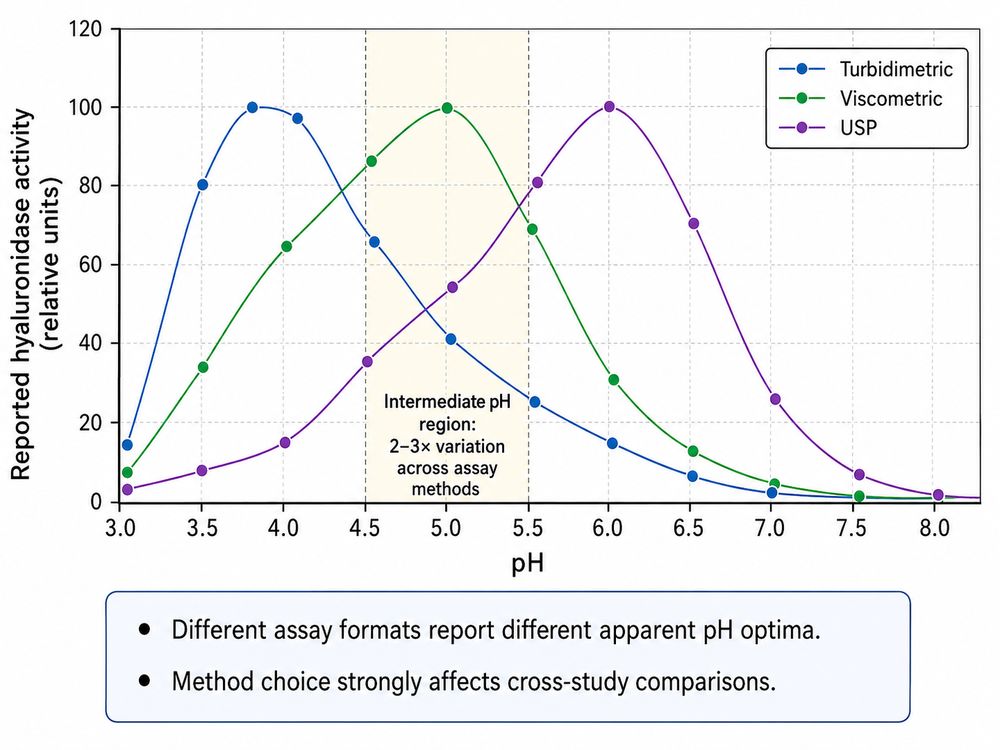
Fig 1. Effect of pH on hyaluronidase activity across turbidimetric, viscometric, and USP assay methods. Note the distinct optima and the 2- to 3-fold variation in reported activity at intermediate pH values.
5. Substrate, pH, Temperature, and Time Dependence
Building on the previous section, we provide a detailed examination of how each variable interacts with human hyaluronidase PH20 biochemistry to influence measured activity.
5.1 Substrate Specificity and Batch Variability
Commercial hyaluronic acid preparations vary in molecular weight distribution, endotoxin content, and protein contamination. Even "pharmaceutical grade" HA from different manufacturers can produce 15-25% differences in measured hyaluronidase activity. Some suppliers supplement assays with bovine serum albumin (BSA) to stabilize the enzyme, which can artificially inflate activity values by 10-20% through nonspecific protein-protein interactions rather than true catalytic enhancement.
5.2 pH Buffer Systems
The choice of buffer extends beyond simple pH maintenance. Acetate, citrate, and phosphate buffers at the same pH create different microenvironments:
- Acetate (pH 4.5): Weak buffering capacity but minimal metal chelation; preferred for turbidimetric assays.
- Citrate (pH 4.5-5.0): Strong chelation of divalent cations (Ca²⁺, Mg²⁺) that PH20 requires for optimal activity; may reduce activity by 20-30%.
- Phosphate (pH 6.0-7.0): Used in USP assays; phosphate ions can compete with substrate binding at the active site, reducing apparent affinity.
5.3 Thermal Stability Considerations
While 37°C is standard, recombinant human hyaluronidase PH20 exhibits temperature-dependent stability. Extended incubation at 37°C (>30 minutes) can cause progressive denaturation, particularly for less stable mutants or formulations lacking stabilizers. Conversely, assays at 25°C may underestimate the enzyme's physiological potential. For preclinical studies intending to model human pharmacology, 37°C is mandatory; for quality control screening, 25°C may be acceptable if consistently applied.
5.4 Time-Course Linearity
Accurate activity determination requires demonstration of linear product formation over time. For hyaluronidase, linearity typically holds for the first 10-15 minutes under standard conditions. Beyond this interval, substrate depletion and accumulation of low-MW HA fragments (which are poorer substrates) cause downward curvature. Reporting activity without validating linearity introduces systematic error.
6. Why Different Suppliers' Units May Not Be Directly Comparable
When purchasing hyaluronidase from multiple suppliers, researchers often assume that "1,000 U" from Supplier A equals "1,000 U" from Supplier B. This assumption is rarely valid. The following factors create invisible incompatibilities:
Assay Method Divergence: Supplier A may use the turbidimetric assay (pH 4.5, 37°C, 10 min), while Supplier B uses the USP mucin clot assay (pH 6.0, 37°C, 45 min). These methods can yield activity values differing by 2- to 5-fold for the same enzyme preparation.
Substrate Sourcing: Supplier A uses rooster comb HA; Supplier B uses Streptococcus zooepidemicus-derived HA. The bacterial product has different N-acetylglucosamine linkage patterns and molecular weight distributions, altering enzyme accessibility.
Unit Definition Ambiguity: Some suppliers define 1 U as the amount causing a 50% reduction in turbidity, while others define it as the amount releasing 1 μmol of N-acetylglucosamine equivalents. These definitions are not mathematically equivalent.
Protein Concentration Discrepancies: A vial labeled "1,000 U" may contain 0.1 mg (high specific activity) or 1.0 mg (low specific activity) of protein. Without specific activity data, dosing by units alone leads to massive protein load differences.
Never assume unit equivalence across suppliers. Always request the Certificate of Analysis (COA) specifying assay method, substrate, pH, temperature, and reaction time. For critical experiments, calibrate all preparations against a common internal standard.
Table 4. Typical Assay Conditions Used by Major Hyaluronidase Suppliers
| Supplier Type | Assay Method | pH | Temperature | Substrate Source | Typical Specific Activity |
|---|---|---|---|---|---|
| Research-grade Vendor A | Turbidimetric | 4.5 | 37°C | Rooster comb HA | 50,000-100,000 U/mg |
| Research-grade Vendor B | Turbidimetric | 4.5 | 25°C | Bacterial HA | 30,000-60,000 U/mg |
| Clinical-grade Manufacturer | USP (Mucin clot) | 6.0 | 37°C | USP reference standard | Not reported (U/vial only) |
| Specialty Enzyme Supplier | Viscometric | 5.0 | 37°C | High-MW HA (>1,500 kDa) | 80,000-150,000 U/mg |
7. How to Report Activity in Publications and Internal Reports
Transparent reporting of hyaluronidase activity is essential for reproducibility. The following checklist ensures that readers can interpret and replicate your measurements:
Mandatory Reporting Elements:
- Unit definition: Specify whether U, KU, USP U, or custom-defined units are used.
- Assay method: Cite the specific protocol (e.g., "modified Dale and White turbidimetric assay" or "USP <89>").
- Substrate details: Report source (rooster comb, bacterial, synthetic), catalog number, molecular weight, and concentration.
- Buffer composition: Include buffer species, pH, ionic strength, and any additives (BSA, NaCl, Ca²⁺).
- Temperature and time: State incubation temperature (±0.5°C) and exact reaction duration.
- Detection parameters: For turbidimetric assays, report wavelength and instrument model.
- Protein quantification method: Specify A280 (with extinction coefficient), Bradford, or amino acid analysis.
- Specific activity: Always report U/mg alongside total U or U/mL.
Example of Complete Reporting:
8. Practical Conversion and Interpretation Notes
While exact conversion between unit systems is impossible without experimental calibration, the following rules of thumb assist in rough estimation:
Turbidimetric U to USP U: 1 turbidimetric U ≈ 0.3-0.5 USP U. The USP assay is less sensitive and typically yields lower numerical values for the same enzyme amount.
25°C to 37°C Correction: Multiply 25°C activity by 1.8-2.2 to estimate 37°C activity, assuming the enzyme is stable at the higher temperature.
Specific Activity Benchmarking: For recombinant human hyaluronidase PH20, specific activity below 50,000 U/mg (turbidimetric) suggests significant inactivation or impurities. Above 200,000 U/mg may indicate assay artifact or protein concentration underestimation.
Volume-to-Mass Conversion: To convert U/mL to mg/mL, divide by specific activity (U/mg). This requires knowing the specific activity of the specific lot, not just the product average.
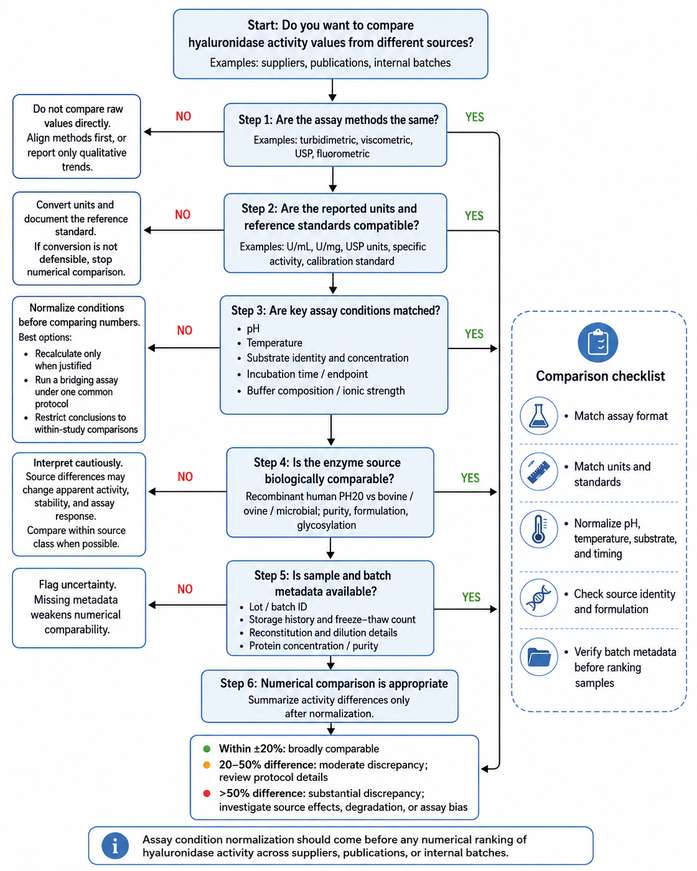
Fig 2. Decision flowchart for comparing hyaluronidase activity across suppliers, publications, and internal batches. The process emphasizes assay condition normalization before numerical comparison.
9. Checklist for Comparing Hyaluronidase Data
Before comparing hyaluronidase activity values from different sources, verify each item below:
Table 5. Checklist for Cross-Study Hyaluronidase Activity Comparison
| Check Item | Question to Answer | Action if Mismatch |
|---|---|---|
| Unit definition | Are both values using the same unit system (U, KU, USP, custom)? | Request COA or protocol details; do not assume equivalence |
| Assay method | Are both using turbidimetric, viscometric, USP, or colorimetric? | Apply empirical conversion factor or re-assay with common method |
| Substrate | Is the substrate source, MW, and concentration identical? | Normalize to common substrate or report as "substrate-specific activity" |
| pH | Are pH values within 0.2 units of each other? | Use pH-activity profile to mathematically correct (if available) |
| Temperature | Are both at 37°C, or is one at 25°C? | Apply Arrhenius correction (~2× per 10°C) or re-assay at 37°C |
| Reaction time | Are both within the linear phase (<15 min)? | Verify linearity; discard nonlinear measurements |
| Protein quantification | Are both using the same protein assay (A280, Bradford, BCA)? | Re-quantify with common method; report both total activity and specific activity |
| Enzyme source | Are both recombinant PH20, or is one bovine testicular? | Do not compare across species; substrate specificity differs |
| Formulation | Are stabilizers, excipients, or preservatives present? | Account for potential assay interference from BSA, glycerol, or salts |
| Batch/lot number | Are data from the same production lot? | Request inter-batch CV; activity can vary 10-20% between lots |
For any study requiring precise hyaluronidase activity quantification—whether for enzyme kinetics, drug formulation, or in vivo pharmacology—we strongly recommend establishing an internal reference standard. Prepare a single large batch of well-characterized enzyme, determine its specific activity under your standard conditions, and use this material to normalize all subsequent measurements. This practice eliminates supplier-to-supplier variability and ensures longitudinal consistency in your data.
References
1. Meyer, K. (1947). The biological significance of hyaluronic acid and hyaluronidase. Physiol Rev, 27(3): 335-359.
2. Dale, B. A., & White, J. C. (1969). A turbidimetric assay for hyaluronidase. Anal Biochem, 31(1): 102-111.
3. United States Pharmacopeia and National Formulary (USP-NF). (2023). Hyaluronidase monograph. Rockville, MD: United States Pharmacopeial Convention.
4. Frost, G. I., & Stern, R. (2010). HYAL2. In: Handbook of Proteolytic Enzymes, 3rd ed. Barrett, A. J., Rawlings, N. D., & Woessner, J. F. (Eds.). Academic Press, pp. 1897-1901.
5. Csoka, A. B., Frost, G. I., & Stern, R. (2001). The six hyaluronidase-like genes in the human and mouse genomes. Matrix Biol, 20(8): 499-508.
6. Arming, S., et al. (2011). Determination of hyaluronidase activity and isoform contribution in biological samples. Glycobiology, 21(5): 602-610.
7. Stern, R., & Jedrzejas, M. J. (2006). Hyaluronidases: their genomics, structures, and mechanisms of action. Chem Rev, 106(3): 818-839.
8. Bookbinder, L. H., et al. (2006). A recombinant human enzyme for enhanced interstitial transport of therapeutics. J Control Release, 114(2): 230-241.