
Recombinant Human Acid Alpha-Glucosidase Production and Critical Quality Attributes
Expression Strategy, Glycosylation, Lysosomal Targeting, Activity, Purity, and Stability of Recombinant Human GAA
Abstract
Recombinant human acid alpha-glucosidase (rhGAA) is a complex lysosomal glycoprotein used in Pompe disease research, enzyme replacement studies, uptake assays, glycogen-clearance experiments, and analytical method development. Producing an active molecule is not sufficient by itself. The material must also retain appropriate folding, N-linked glycosylation, mannose-6-phosphate (M6P)-dependent uptake potential, catalytic performance under acidic conditions, low levels of aggregates and process-related impurities, and acceptable stability during storage and handling.
These requirements make rhGAA substantially more challenging than a small, non-glycosylated recombinant enzyme. Expression host, clone selection, cell culture conditions, harvest strategy, purification sequence, formulation, and fill-finish operations can all alter the final quality profile. This white paper reviews the production logic and critical quality attributes most relevant to research-grade and therapeutic-grade GAA materials, with emphasis on attributes that influence lysosomal delivery and experimental reproducibility.
recombinant human GAA, acid alpha-glucosidase production, CHO expressed GAA, recombinant enzyme quality control, alglucosidase alfa characterization, lysosomal enzyme manufacturing
1. Why Recombinant Human GAA Is Technically Challenging
Human GAA is synthesized as a large precursor glycoprotein that enters the endoplasmic reticulum, acquires multiple N-linked glycans, moves through the Golgi apparatus, and is normally routed to lysosomes through mannose-6-phosphate receptor pathways. After lysosomal delivery, proteolytic processing generates mature enzyme species with altered molecular mass and catalytic properties. A recombinant production process must therefore support several interconnected events: high-level expression, correct folding, secretion, glycan maturation, phosphorylation of selected mannose residues, structural stability, and preservation of catalytic activity.
The production challenge is amplified by the fact that different assays interrogate different aspects of quality. A preparation may hydrolyze a small fluorogenic substrate yet show weak cellular uptake because its M6P content is low. Another lot may have acceptable purity by SDS-PAGE but contain soluble oligomers that affect receptor binding or cellular responses. For this reason, a useful recombinant human acid alpha-glucosidase preparation should be evaluated as a multidimensional product rather than as a single activity value.
| Technical Challenge | Why It Matters | Potential Consequence if Uncontrolled |
|---|---|---|
| Complex glycosylation | Influences folding, stability, clearance, receptor interaction, and lysosomal targeting | Reduced uptake or altered pharmacological behavior |
| Large multidomain protein | Requires coordinated folding and disulfide formation | Misfolding, aggregation, low secretion, or reduced activity |
| Proteolytic maturation | Precursor and mature forms may differ in activity and cellular handling | Inconsistent potency or misleading molecular-weight profiles |
| M6P heterogeneity | Controls CI-MPR-mediated internalization in many cell models | Weak lysosomal delivery despite adequate in vitro activity |
| Acidic catalytic environment | Activity must be measured under lysosome-relevant conditions | Assay results that do not predict intracellular performance |
2. Expression Systems for Therapeutic Enzymes
Expression platform selection determines which post-translational modifications the recombinant enzyme can receive. Bacterial systems are efficient for many cytosolic enzymes, but they do not naturally reproduce mammalian N-glycosylation or M6P formation. Yeast, insect, plant, transgenic animal, and mammalian cell systems can produce glycosylated proteins, yet each generates a distinct glycan profile and therefore a different balance of secretion, stability, receptor recognition, and immunological risk.
For a lysosomal enzyme, the most appropriate host depends on the intended application. A non-mammalian system may be suitable for antibody production, biochemical screening, substrate specificity studies, or structure-function work if uptake is not required. By contrast, cell-based glycogen-clearance studies usually require material with demonstrated receptor-mediated internalization and lysosomal localization.
| Expression System | Advantages | Limitations for GAA | Typical Research Use |
|---|---|---|---|
| CHO or other mammalian cells | Mammalian folding, secretion, disulfide formation, and complex glycosylation | Higher cost, longer development, glycan heterogeneity | Cell uptake, lysosomal delivery, translational studies |
| Human cell lines | Human-like processing and glycosylation potential | Process complexity and host-cell impurity considerations | Comparability and specialized glycosylation studies |
| Insect cells | Good secretion and scalable baculovirus workflows | Non-human glycan structures and limited native M6P processing | Structural biology and biochemical characterization |
| Yeast | Robust growth and high volumetric productivity | Hypermannosylation and non-mammalian glycan patterns | Enzyme engineering after glycoengineering |
| Plant or moss platforms | Flexible glycoengineering and alternative mannose-rich glycans | Plant-specific glycans unless engineered; uptake mechanism may differ | Alternative receptor-targeting strategies |
| E. coli | Fast, economical, and easy to manipulate | No mammalian N-glycosylation; refolding may be difficult | Domains, antibodies, standards, or non-cellular assays |
3. CHO Expression and Mammalian Glycosylation
Chinese hamster ovary cells are widely used for recombinant lysosomal enzymes because they combine scalable suspension culture with mammalian secretory-pathway processing. CHO-derived GAA can be secreted as a precursor glycoprotein and can carry N-linked glycans that support folding, solubility, and receptor-mediated uptake. Alglucosidase alfa is produced by recombinant DNA technology in CHO cells, illustrating the importance of this platform for clinically relevant GAA production.
CHO expression does not automatically guarantee a uniform product. Clone-to-clone differences, culture duration, nutrient availability, dissolved oxygen, pH, temperature shifts, and harvest timing can alter glycan occupancy, terminal sugar composition, phosphorylation, charge variants, clipping, and aggregation. Upstream development should therefore screen clones not only for titer but also for specific activity, glycan profile, M6P-related uptake, and stability.
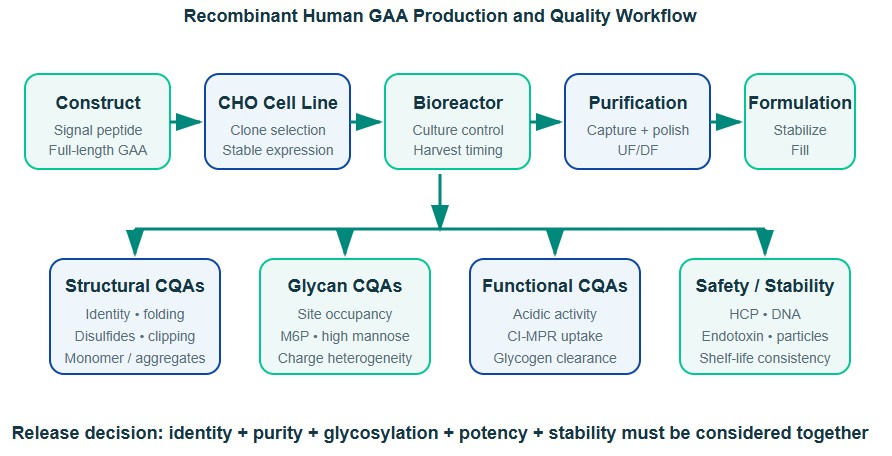
Figure 1: Integrated production workflow for CHO-expressed recombinant human GAA, from construct design and cell culture to purification, formulation, and release characterization.
The highest-producing clone is not necessarily the best product-producing clone. Selection should combine productivity with glycosylation, uptake, specific activity, and aggregate control.
4. Protein Folding and Post-Translational Modification
Newly synthesized GAA enters the endoplasmic reticulum through an N-terminal signal peptide. Chaperone-assisted folding, disulfide formation, N-glycan attachment, and quality-control checkpoints determine whether the protein proceeds to secretion or is retained and degraded. Misfolded GAA can increase intracellular stress, lower process yield, and contribute to aggregate or fragment formation after harvest.
Post-translational modification should be considered at several levels. N-glycan site occupancy can influence local structure; high-mannose and complex glycans can affect receptor interaction and clearance; phosphorylation creates M6P-containing species; terminal sialylation can change charge and circulation behavior; and proteolytic clipping can alter molecular form or activity. Orthogonal methods are needed because no single assay captures this heterogeneity.
| Attribute | Recommended Analytical Approach | Interpretation |
|---|---|---|
| Primary structure and sequence integrity | Intact mass, peptide mapping, LC-MS/MS | Confirms identity, sequence coverage, and unexpected clipping |
| Disulfide connectivity | Non-reduced peptide mapping, differential alkylation | Supports correct folding and structural consistency |
| N-glycan occupancy and profile | Released-glycan analysis, glycopeptide mapping, HILIC-FLD-MS | Defines glycan heterogeneity and site-specific differences |
| Charge variants | icIEF, CEX-HPLC, capillary electrophoresis | Detects effects of sialylation, deamidation, phosphorylation, and clipping |
| Precursor and processed forms | Reducing/non-reducing SDS-PAGE, CE-SDS, immunoblotting | Distinguishes molecular species and processing consistency |
| Higher-order structure | CD, fluorescence spectroscopy, DSC, HDX-MS where appropriate | Monitors conformational integrity and thermal stability |
5. Mannose-6-Phosphate Relevance for Lysosomal Delivery
M6P is one of the most functionally important glycan-related attributes of recombinant GAA. In many target cells, extracellular enzyme binds the cation-independent mannose-6-phosphate receptor (CI-MPR), undergoes endocytosis, traffics through endosomal compartments, and reaches lysosomes. The efficiency of this pathway depends not only on total M6P content but also on glycan accessibility, mono- versus bis-phosphorylated structures, receptor density, competition with endogenous ligands, and disease-related trafficking defects.
Consequently, M6P should not be treated as a purely compositional measurement. Functional testing can include CI-MPR binding, competition with free M6P, cellular uptake, lysosomal colocalization, intracellular maturation, and glycogen reduction. Glycoengineering strategies that increase receptor affinity have demonstrated that improved targeting can enhance muscle-cell uptake and pharmacodynamic correction.
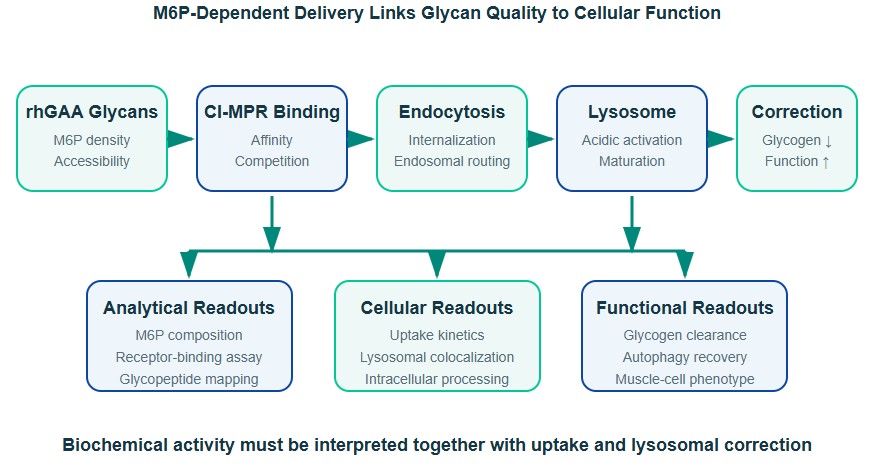
Figure 2: M6P-dependent pathway connecting glycan quality to CI-MPR binding, cellular uptake, lysosomal delivery, enzyme maturation, and glycogen degradation.
For uptake-dependent experiments, the CHO-expressed GAA enzyme should therefore be qualified with a cell-based assay rather than selected solely from an activity result obtained with a soluble artificial substrate.
6. Purity, Endotoxin, and Aggregation Control
Purification must remove host-cell proteins, residual DNA, media components, proteases, product fragments, charge variants, and aggregates without damaging the enzyme or stripping functionally important glycan species. A typical process may combine capture chromatography, ion exchange, hydrophobic interaction or mixed-mode steps, ultrafiltration/diafiltration, and a final polishing operation. The exact sequence should be guided by the impurity profile and by product recovery rather than by a generic protein purification template.
Aggregates deserve special attention because they can reduce recoverable activity, alter receptor interactions, increase nonspecific cellular uptake, and confound immunogenicity-related research. Endotoxin is also critical for cell-based assays: even when enzyme purity is high, bacterial endotoxin introduced through raw materials or handling can trigger inflammatory signaling and distort transcriptional or cytokine endpoints.
| Quality Attribute | Common Methods | Research Impact |
|---|---|---|
| Identity | Peptide mapping, intact mass, immunoreactivity | Confirms the material is human GAA |
| Purity | CE-SDS, SDS-PAGE, RP-HPLC | Reduces interference from fragments and co-purifying proteins |
| Aggregates | SEC-HPLC, SEC-MALS, AUC, DLS | Supports consistent receptor interaction and cellular response |
| Host-cell proteins | Platform or process-specific HCP ELISA, LC-MS | Limits assay interference and unintended immune stimulation |
| Residual DNA | qPCR or fluorescence-based assays | Monitors process clearance and material cleanliness |
| Endotoxin | LAL or recombinant factor C assay | Essential for macrophage, muscle-cell, and cytokine studies |
| Bioburden and sterility-related controls | Compendial microbial methods as appropriate | Protects long-duration cell and animal experiments |
7. Enzymatic Activity and Lot-to-Lot Consistency
GAA activity is commonly measured with fluorogenic or chromogenic α-glucoside substrates under acidic conditions. These assays are useful for release testing and specific-activity calculations, but they may not fully reproduce the steric complexity of glycogen or the intracellular environment. A robust characterization strategy can therefore combine a small-substrate assay with a natural-substrate or glycogen-degradation method and a cell-based uptake or glycogen-clearance assay.
Assay conditions must be standardized. pH, ionic strength, incubation time, substrate concentration, enzyme concentration, temperature, and quench conditions can all influence the reported result. Acceptance ranges should be linked to a qualified reference lot and to assay precision. When lots are compared, activity should be normalized both per mass of total protein and, where possible, per amount of intact monomeric GAA.
A Practical Three-Layer Potency Strategy
- Biochemical catalytic activity: rapid quantitation with a defined synthetic substrate at acidic pH.
- Substrate-relevant activity: hydrolysis of glycogen, maltose, or defined α-1,4/α-1,6-containing substrates.
- Cellular functional activity: receptor-mediated uptake, lysosomal localization, intracellular maturation, and reduction of stored glycogen.
Lot-to-lot consistency should also include glycan distribution, M6P-related function, monomer percentage, charge profile, and thermal stability. Two lots with similar catalytic units can behave differently in cells if their uptake-related attributes are not comparable.
8. Storage, Reconstitution, and Stability Considerations
Recombinant GAA can lose quality through aggregation, surface adsorption, oxidation, deamidation, clipping, freeze-thaw stress, or prolonged exposure to unsuitable pH and temperature. Stability programs should evaluate both physical and functional change. A sample may remain visually clear while its specific activity or uptake capacity declines.
Lyophilized material generally requires controlled reconstitution. The diluent should be added gently along the vial wall, and vigorous shaking should be avoided because air-liquid interfaces and foaming can promote aggregation. Reconstituted solutions should be inspected for visible particles and handled according to validated hold times. For research use, repeated freeze-thaw cycles should be minimized by preparing single-use aliquots when compatible with the formulation.
| Stability Risk | Study Design | Suggested Readouts |
|---|---|---|
| Long-term storage | Real-time storage at the recommended condition | Activity, SEC, CE-SDS, appearance, pH, charge profile |
| Accelerated degradation | Elevated temperature or agitation challenge | Aggregation kinetics, clipping, potency loss |
| Freeze-thaw stress | Defined repeated cycles with controlled thawing | SEC, DLS, activity, particle analysis |
| Reconstituted hold time | Bench-top and refrigerated hold studies | Activity, visible/subvisible particles, microbial risk as applicable |
| Container interaction | Vial, tube, syringe, and low-binding material comparison | Protein recovery, adsorption, particle formation |
| Shipping excursion | Temperature and vibration simulation | Appearance, activity, aggregate content, package integrity |
9. Research-Grade vs Therapeutic-Grade Enzyme Materials
Research-grade and therapeutic-grade materials may share the same protein identity but are not interchangeable categories. Therapeutic manufacturing requires validated current good manufacturing practice controls, qualified raw materials, process validation, extensive viral safety strategies, formal stability programs, release specifications, regulatory documentation, and controlled distribution. Research-grade material may be produced with a narrower quality system and is intended for laboratory investigation rather than administration to humans.
However, “research grade” should not mean poorly characterized. For mechanistic cell studies, preclinical method development, or comparability work, researchers may need detailed data on purity, endotoxin, activity, aggregation, glycosylation, and M6P-related uptake. The necessary depth of characterization should be determined by the scientific question.
| Criterion | Research-Grade GAA | Therapeutic-Grade GAA |
|---|---|---|
| Intended use | In vitro, analytical, method development, and preclinical research | Human administration under approved or investigational use |
| Quality system | Supplier-defined research quality controls | GMP manufacturing and formal regulatory oversight |
| Release testing | Selected identity, purity, activity, endotoxin, and stability tests | Validated specification panel covering identity, purity, potency, safety, and dosage form |
| Viral safety | May be limited to source and process controls | Qualified cell banks, viral testing, and validated clearance/inactivation strategy |
| Traceability | Lot-level certificate and supporting characterization | Full batch records, validated methods, deviations, change control, and regulatory documentation |
| Clinical suitability | Not for human use | Designed and released for clinical administration |
10. Checklist for Selecting Recombinant GAA
Selection should begin with the intended experiment. A biochemical inhibitor screen may prioritize catalytic activity and purity, whereas a Pompe disease cell model requires receptor-mediated uptake and lysosomal correction. The following checklist can help align product attributes with experimental risk.
- Confirm protein identity and species: verify full-length human GAA, construct boundaries, tags, and whether the tag is removable or may affect uptake.
- Review the expression host: select a mammalian product when native-like folding and glycosylation are central to the study.
- Request glycosylation information: look for N-glycan profiling, site occupancy, high-mannose species, and M6P-related data when lysosomal delivery is required.
- Evaluate molecular form: determine whether the material is predominantly precursor GAA, partially processed enzyme, or a mixture.
- Check purity and aggregation: use quantitative SEC or equivalent data rather than relying only on a gel image.
- Assess activity in a relevant assay: confirm assay pH, substrate, unit definition, reference standard, and specific activity.
- Confirm cell-based function: for uptake studies, request CI-MPR-dependent internalization, lysosomal localization, or glycogen-clearance evidence.
- Review endotoxin and microbial controls: especially for immune-cell, muscle-cell, organoid, and animal experiments.
- Examine formulation and stability: document storage condition, reconstitution instructions, freeze-thaw tolerance, and post-thaw or post-reconstitution hold time.
- Compare lots using orthogonal data: prioritize suppliers that provide lot-specific certificates and support comparability across projects.
The best recombinant GAA is not simply the lot with the highest activity value. It is the material whose expression system, glycan profile, uptake properties, purity, stability, and documentation match the biological question.
For studies requiring a mammalian-expressed lysosomal enzyme, alglucosidase alfa recombinant human GAA can support biochemical characterization, enzyme activity assays, cellular uptake studies, glycogen degradation research, and translational method development when used with application-appropriate controls.
References
1. Moreland, R. J., et al. (2005). Lysosomal acid alpha-glucosidase consists of four different peptides processed from a single-chain precursor. Journal of Biological Chemistry, 280(8): 6780-6791.
2. Roig-Zamboni, V., et al. (2017). Structure of human lysosomal acid α-glucosidase—a guide for the treatment of Pompe disease. Nature Communications, 8: 1111.
3. Fuller, M., et al. (1995). Isolation and characterisation of a recombinant precursor form of lysosomal acid alpha-glucosidase. European Journal of Biochemistry, 234(3): 903-909.
4. van Hove, J. L. K., et al. (1996). High-level production of recombinant human lysosomal acid alpha-glucosidase in Chinese hamster ovary cells. Proceedings of the National Academy of Sciences USA, 93(1): 65-70.
5. European Medicines Agency. Myozyme: EPAR Product Information. Alglucosidase alfa produced in Chinese hamster ovary cells by recombinant DNA technology.
6. U.S. Food and Drug Administration. Lumizyme (alglucosidase alfa) Prescribing Information.
7. Zhu, Y., et al. (2009). Glycoengineered acid alpha-glucosidase with improved efficacy at correcting metabolic abnormalities in a mouse model of Pompe disease. Molecular Therapy, 17(6): 954-963.
8. Cardone, M., et al. (2008). Abnormal mannose-6-phosphate receptor trafficking impairs recombinant alpha-glucosidase uptake in Pompe disease fibroblasts. Pathogenetics, 1: 6.
9. Maga, J. A., et al. (2013). Glycosylation-independent lysosomal targeting of acid alpha-glucosidase enhances muscle glycogen clearance. Journal of Biological Chemistry, 288(3): 1428-1438.
10. Parenti, G., et al. (2015). New strategies for the treatment of lysosomal storage diseases. International Journal of Molecular Sciences, 16(4): 7797-7813.
11. Tiels, P., et al. (2012). A bacterial glycosidase enables mannose-6-phosphate modification and improved cellular uptake of recombinant lysosomal enzymes. Nature Biotechnology, 30(12): 1225-1231.
12. Lee, K., et al. (2018). N-glycan remodeling to increase high-mannose glycans of recombinant human acid alpha-glucosidase. Scientific Reports, 8: 16038.
13. Raben, N., et al. (2003). Enzyme replacement therapy in the mouse model of Pompe disease. Molecular Genetics and Metabolism, 80(1-2): 159-169.
14. Kishnani, P. S., et al. (2007). Recombinant human acid alpha-glucosidase: major clinical benefits in infantile-onset Pompe disease. Neurology, 68(2): 99-109.
15. ICH Q6B. Specifications: Test Procedures and Acceptance Criteria for Biotechnological/Biological Products.
16. ICH Q5C. Quality of Biotechnological Products: Stability Testing of Biotechnological/Biological Products.
17. United States Pharmacopeia. General chapters for biotechnology-derived proteins, endotoxin testing, particulate matter, and analytical procedure validation.
18. Walsh, G. (2018). Biopharmaceutical benchmarks 2018. Nature Biotechnology, 36: 1136-1145.