
Mannose-6-Phosphate Receptor-Mediated Delivery of Acid Alpha-Glucosidase
How Glycan Recognition, Cellular Uptake, and Intracellular Trafficking Shape Recombinant GAA Performance
Abstract
Efficient delivery of recombinant acid alpha-glucosidase (GAA) requires more than preserved catalytic activity. The enzyme must carry accessible lysosomal targeting glycans, bind an appropriate cell-surface receptor, enter the endosomal pathway, reach acidic lysosomes, and remain functional long enough to reduce accumulated glycogen. The mannose-6-phosphate (M6P) pathway, particularly uptake through the cation-independent mannose-6-phosphate receptor (CI-MPR/IGF2R), is therefore a central determinant of recombinant GAA performance in Pompe disease enzyme replacement research.
This review connects the molecular basis of lysosomal enzyme sorting with practical evaluation of recombinant acid alpha-glucosidase. It discusses glycan-dependent receptor binding, endosomal trafficking, tissue-specific limitations, assay design, and emerging strategies intended to improve lysosomal delivery to skeletal muscle, cardiac muscle, and other disease-relevant tissues.
mannose-6-phosphate receptor, GAA uptake, acid alpha-glucosidase delivery, lysosomal enzyme targeting, recombinant GAA, Pompe disease ERT
1. Introduction to Lysosomal Enzyme Targeting
Lysosomal hydrolases are synthesized in the endoplasmic reticulum, processed through the Golgi apparatus, and directed to lysosomes through specific carbohydrate-based recognition signals. For many mammalian lysosomal enzymes, including GAA, the most important signal is M6P displayed on N-linked glycans. This marker allows sorting receptors to distinguish lysosomal enzymes from proteins destined for secretion or other cellular compartments.
The same biological pathway can be exploited after extracellular administration. A fraction of recombinant enzyme carrying suitable M6P structures can bind cell-surface CI-MPR, undergo receptor-mediated endocytosis, and enter the endosomal–lysosomal system. This mechanism is the foundation of cross-correction and is highly relevant to the design and evaluation of acid alpha-glucosidase for Pompe disease research.
| Delivery Requirement | Biological Role | Experimental Question |
|---|---|---|
| M6P-bearing N-glycans | Provide receptor-recognizable lysosomal targeting information | Does the recombinant GAA contain accessible, functionally relevant M6P structures? |
| Cell-surface receptor availability | Supports enzyme binding and internalization | Is CI-MPR sufficiently expressed and recycled in the selected cell model? |
| Endosomal trafficking | Moves internalized enzyme toward lysosomes | Does the enzyme separate from the receptor and reach LAMP-positive compartments? |
| Lysosomal stability and activity | Enables glycogen hydrolysis under acidic conditions | Is intracellular enzyme activity restored after uptake? |
2. Mannose-6-Phosphate and Lysosomal Sorting
M6P is generated through sequential Golgi processing of selected mannose residues on N-glycans. Recognition depends not only on the presence of phosphate but also on glycan architecture, phosphate accessibility, and the number and distribution of receptor-binding structures across the enzyme molecule. Consequently, total carbohydrate content is not an adequate proxy for functional lysosomal targeting.
Two classical M6P receptors participate in intracellular sorting: the cation-dependent M6P receptor and the larger cation-independent M6P receptor. For extracellular enzyme uptake, CI-MPR is especially important because it cycles between the plasma membrane, endosomes, and Golgi-associated compartments and can capture M6P-bearing ligands from the extracellular environment.
| Feature | CD-MPR | CI-MPR / IGF2R |
|---|---|---|
| Relative size | Smaller receptor | Large multifunctional receptor |
| Ligand recognition | M6P-containing glycans | M6P-containing glycans and additional ligands, including IGF-II |
| Role in recombinant enzyme uptake | Can contribute to trafficking | Major receptor commonly associated with extracellular rhGAA uptake |
| Research relevance | Useful for mechanistic comparison | Primary focus of competition, binding, internalization, and receptor-expression studies |
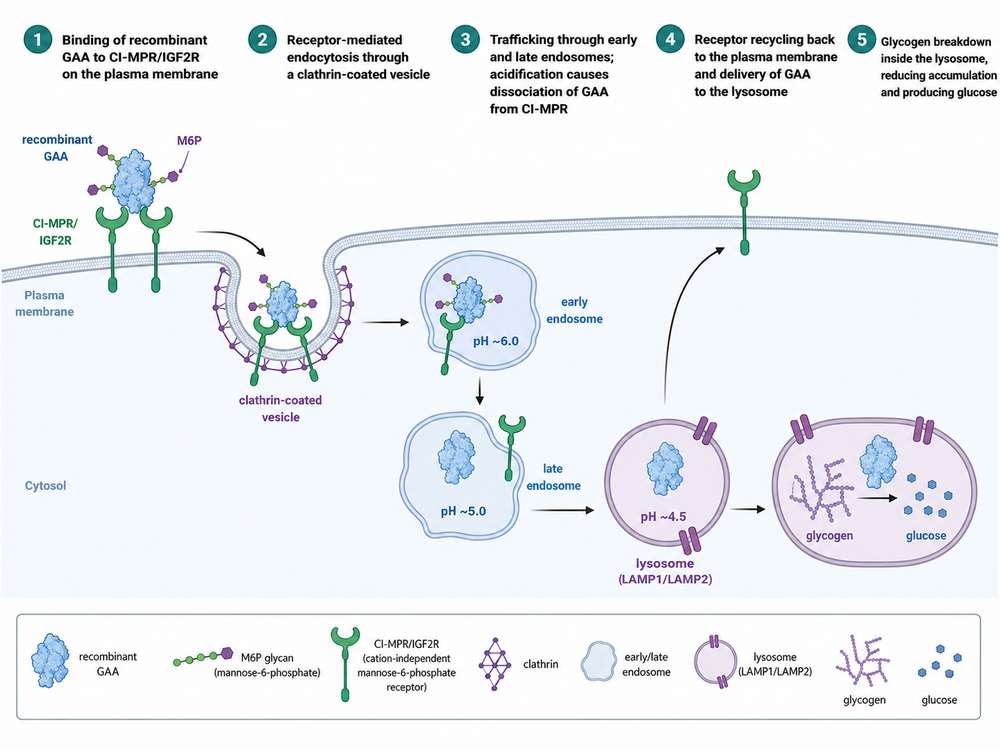
Figure 1: M6P-dependent binding of recombinant GAA to CI-MPR, receptor-mediated endocytosis, endosomal acidification, receptor recycling, and lysosomal delivery.
3. Receptor-Mediated Uptake of Recombinant GAA
The uptake process begins when M6P-bearing glycans on recombinant GAA interact with CI-MPR at the plasma membrane. Receptor–ligand complexes concentrate in endocytic structures and are internalized. Uptake is saturable, cell-type dependent, and sensitive to receptor abundance, receptor recycling, ligand glycan quality, extracellular enzyme concentration, and competing ligands.
Binding should be distinguished from productive uptake. Surface-associated enzyme may generate an apparent signal without entering the cell, while internalized enzyme may remain trapped in endosomes or fail to reach lysosomes. A robust study therefore separates surface binding, total internalization, lysosomal localization, enzyme maturation, and functional glycogen clearance.
| Stage | Key Event | Recommended Readout |
|---|---|---|
| Surface binding | GAA associates with CI-MPR | 4°C binding assay, flow cytometry, receptor-blocking experiment, or surface biotinylation |
| Internalization | Receptor–enzyme complex enters the cell | Temperature shift to 37°C, acid wash, protease stripping, or labeled-GAA quantification |
| Intracellular delivery | GAA traffics through endosomes | Co-localization with EEA1, RAB5, RAB7, or endosomal probes |
| Lysosomal arrival | GAA accumulates in acidic LAMP-positive compartments | LAMP1/LAMP2 co-localization, LysoTracker imaging, or subcellular fractionation |
| Functional correction | Internalized enzyme hydrolyzes lysosomal glycogen | Intracellular activity recovery and glycogen reduction |
4. Intracellular Trafficking to Lysosomes
Following internalization, the receptor–enzyme complex enters early endosomes. Progressive acidification weakens receptor–ligand interactions and supports release of GAA from CI-MPR. The receptor can recycle to the cell surface or return toward Golgi-associated compartments, while the enzyme proceeds through late endosomes to lysosomes.
Within acidic compartments, precursor GAA can undergo proteolytic processing into mature enzyme forms. Western blot analysis may therefore provide information beyond total protein abundance: the presence of processed species can support successful trafficking and maturation. However, processing patterns depend on cell type, exposure time, and experimental conditions and should be interpreted together with localization and activity measurements.
High intracellular GAA signal does not automatically indicate successful lysosomal delivery. Productive delivery should be supported by co-localization, enzyme maturation, acidic-compartment activity, and reduction of accumulated glycogen.
5. Impact of Glycosylation on Uptake Efficiency
Recombinant GAA is a heavily glycosylated protein, and production platform, clone selection, culture conditions, downstream processing, and post-expression glycan engineering can alter its glycan profile. The quantity and accessibility of mono- and bis-phosphorylated structures can affect receptor affinity and cellular uptake. Other terminal glycan features may influence systemic clearance, off-target capture, or uptake through non-M6P pathways.
For this reason, glycan characterization and cell-based uptake should be treated as complementary analyses. A preparation may show strong catalytic activity in a cell-free assay yet perform poorly in muscle cells if the receptor-binding glycan structures are insufficient or poorly exposed.
| Glycan Attribute | Potential Effect | Analytical Approach |
|---|---|---|
| M6P abundance | Influences probability of CI-MPR recognition | LC-MS glycan analysis, M6P quantification, receptor-binding assay |
| Phosphate valency and distribution | May affect avidity and uptake efficiency | Site-specific glycopeptide mapping and functional uptake comparison |
| High-mannose structures | May alter clearance or enable recognition by mannose-binding receptors | Released glycan profiling and receptor-selective competition studies |
| Complex terminal glycans | May affect circulation, receptor access, and nonspecific uptake | Glycan composition analysis and multi-cell-type uptake testing |
| Glycan accessibility | Determines whether receptor-binding epitopes are sterically available | CI-MPR binding kinetics and cell-based internalization assays |
6. Tissue-Specific Delivery Challenges
Systemic exposure does not ensure equal delivery to all tissues. Skeletal muscle represents a particularly demanding target because of its large total mass, variable perfusion, extracellular barriers, receptor abundance, fiber-type differences, autophagic pathology, and the need to distribute enzyme across extensive intracellular compartments. Cardiac muscle may show different uptake characteristics, while liver and other clearance organs can capture a substantial fraction of circulating glycoprotein.
Receptor abundance and receptor trafficking are dynamic rather than fixed. Differentiation state, disease severity, age, inflammatory context, and metabolic signaling can change CI-MPR availability. Therefore, uptake data from fibroblasts or undifferentiated cell lines should not be assumed to predict delivery to mature myotubes or in vivo muscle.
| Tissue or Model | Delivery Consideration | Recommended Experimental Emphasis |
|---|---|---|
| Skeletal muscle / myotubes | Variable receptor expression, large target mass, autophagic accumulation | Differentiated myotubes, long-term glycogen clearance, receptor quantification |
| Cardiomyocytes | High disease relevance in infantile Pompe models | Lysosomal delivery, glycogen burden, contractility-linked endpoints |
| Fibroblasts | Accessible and reproducible but not fully muscle-representative | Mechanistic receptor studies, uptake kinetics, trafficking defects |
| Hepatic cells | Potential systemic clearance and alternate glycan receptor uptake | Off-target uptake and glycan-dependent clearance mechanisms |
| Animal tissue | Integrates circulation, barriers, immune response, and biodistribution | Tissue enzyme activity, glycogen, histology, receptor expression, and pharmacokinetics |
7. Assays for Receptor-Mediated Uptake
A well-designed uptake experiment uses orthogonal readouts and includes controls that distinguish CI-MPR dependence from nonspecific adsorption, fluid-phase uptake, or alternate receptor pathways. Competition with free M6P or an M6P-containing ligand can test pathway dependence, while receptor knockdown, knockout, or blocking approaches provide stronger mechanistic evidence.
| Assay | What It Measures | Essential Controls | Key Limitation |
|---|---|---|---|
| Fluorescent GAA uptake | Cell-associated and internalized labeled enzyme | 4°C binding, acid wash, unlabeled GAA, M6P competition | Labeling may alter glycans or activity |
| CI-MPR binding assay | Direct receptor interaction or relative affinity | Nonphosphorylated control protein and excess M6P | Does not prove cellular trafficking |
| Intracellular GAA activity | Recovery of acid alpha-glucosidase activity after uptake | Untreated cells, inactive GAA, receptor competition, total protein normalization | Residual surface enzyme may inflate results without adequate washing |
| Immunofluorescence co-localization | Spatial overlap with endosomal or lysosomal markers | Secondary-only controls, untreated cells, time-course samples | Co-localization is sensitive to image resolution and analysis thresholds |
| Western blot processing profile | Total and mature intracellular GAA species | Loading control, extracellular GAA washout, time course | Processing patterns vary between cell types |
| Glycogen clearance assay | Functional correction of storage phenotype | Disease cells, healthy cells, untreated disease cells, inactive-enzyme control | Requires an appropriate baseline glycogen burden and sufficient assay duration |
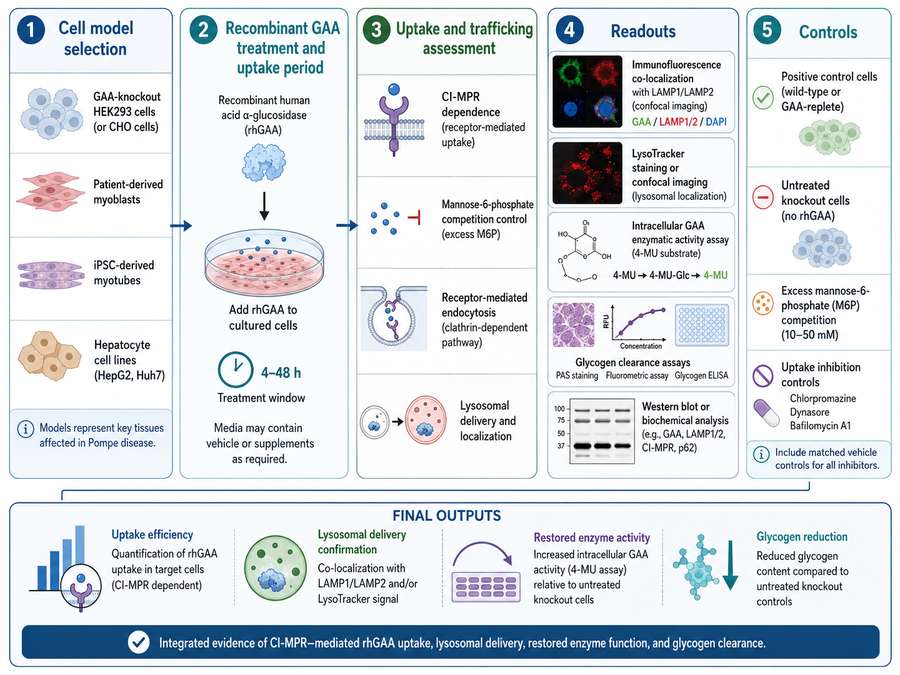
Figure 2: Integrated workflow combining CI-MPR binding, competition controls, cellular internalization, lysosomal co-localization, intracellular enzyme activity, and glycogen clearance.
8. Implications for Next-Generation GAA Engineering
Delivery-focused engineering aims to increase the fraction of administered enzyme that reaches disease-relevant lysosomes. Strategies include enriching M6P-bearing glycans, chemically attaching receptor-binding carbohydrate structures, modifying production conditions, and introducing alternative CI-MPR-binding ligands. Glycosylation-independent lysosomal targeting approaches, such as IGF-II-derived receptor-binding tags, seek to engage CI-MPR without relying exclusively on native M6P abundance.
Engineering must preserve a balanced product profile. Stronger receptor binding can improve internalization, but excessive affinity could alter receptor release or recycling. Added glycans or targeting domains may affect catalytic activity, stability, immunogenicity, pharmacokinetics, and manufacturability. Candidate ranking should therefore integrate receptor binding with cell uptake, lysosomal processing, glycogen clearance, and tissue-level biodistribution.
| Engineering Strategy | Intended Benefit | Development Question |
|---|---|---|
| Higher M6P content | Increase CI-MPR engagement and uptake | Are additional phosphates accessible and functionally active? |
| Bis-M6P or multivalent glycan enrichment | Improve apparent receptor avidity | Does enhanced binding translate into lysosomal delivery rather than surface retention? |
| Chemical glycan remodeling | Add defined targeting ligands after expression | Is conjugation homogeneous and compatible with catalytic activity? |
| IGF-II-derived CI-MPR targeting | Provide glycosylation-independent receptor engagement | How does the targeting domain affect specificity, stability, and immunogenicity? |
| Alternative tissue-targeting modules | Improve delivery to muscle or other difficult tissues | Can tissue selectivity be improved without increasing off-target uptake? |
9. Key Questions in Delivery Optimization
- How much functional M6P is enough? Total M6P quantity should be linked to receptor binding and cell-based uptake rather than interpreted alone.
- Which glycan sites contribute most to productive uptake? Site occupancy and structural accessibility may be as important as total phosphorylation.
- Does higher receptor affinity always improve efficacy? Productive delivery requires binding, internalization, release, receptor recycling, lysosomal maturation, and catalytic function.
- Which cell model best predicts muscle delivery? Mechanistic screens in fibroblasts should be complemented by differentiated muscle models and in vivo tissue analysis.
- How should alternate uptake pathways be measured? Mannose receptors, fluid-phase endocytosis, and other glycan-binding systems may contribute in specific cell types.
- Can receptor availability be pharmacologically or biologically modulated? Receptor expression and trafficking may offer complementary approaches to enzyme engineering.
- How should delivery and catalytic potency be balanced? The best candidate is not necessarily the strongest binder or the most active enzyme in a cell-free assay, but the one that produces sustained lysosomal glycogen reduction.
10. Conclusion
M6P receptor-mediated uptake links recombinant GAA glycosylation to intracellular therapeutic function. An effective molecule must present receptor-recognizable glycans, engage CI-MPR, enter the correct trafficking route, dissociate under endosomal conditions, reach lysosomes, mature appropriately, and reduce glycogen. Any break in this sequence can limit performance even when purified enzyme shows strong catalytic activity.
For research and candidate comparison, GAA uptake and lysosomal delivery should be evaluated through an integrated panel rather than a single assay. Glycan mapping, receptor binding, competition studies, imaging, intracellular activity, processing analysis, and glycogen clearance together provide a more reliable picture of delivery efficiency. These principles are increasingly important as next-generation GAA designs seek improved muscle targeting and more consistent correction of lysosomal glycogen storage.
Recombinant GAA quality is defined not only by purity and catalytic activity, but also by the ability of its glycan and targeting features to support receptor-dependent, tissue-relevant lysosomal delivery.
References
1. Kornfeld, S. (1992). Structure and function of the mannose 6-phosphate/insulin-like growth factor II receptors. Annual Review of Biochemistry, 61: 307–330.
2. Ghosh, P., Dahms, N. M., & Kornfeld, S. (2003). Mannose 6-phosphate receptors: New twists in the tale. Nature Reviews Molecular Cell Biology, 4(3): 202–212.
3. Cardone, M., et al. (2008). Abnormal mannose-6-phosphate receptor trafficking impairs recombinant alpha-glucosidase uptake in Pompe disease fibroblasts. Pathogenetics, 1: 6.
4. Zhu, Y., et al. (2009). Glycoengineered acid alpha-glucosidase with improved efficacy at correcting the metabolic aberrations and motor function deficits in a mouse model of Pompe disease. Molecular Therapy, 17(6): 954–963.
5. Maga, J. A., et al. (2013). Glycosylation-independent lysosomal targeting of acid alpha-glucosidase enhances muscle glycogen clearance in Pompe mice. Journal of Biological Chemistry, 288(3): 1428–1438.
6. Koeberl, D. D., et al. (2014). Adjunctive beta2-agonist treatment enhances CI-MPR-mediated uptake and trafficking of GAA in Pompe disease models. Molecular Genetics and Metabolism, 111(2): 150–158.
7. Hintze, S., et al. (2020). Moss-derived human recombinant GAA provides an optimized enzyme uptake in differentiated muscle cells. International Journal of Molecular Sciences, 21(8): 2642.
8. Meena, N. K., Raben, N., & Nair, V. (2020). Pompe disease: New developments in an old lysosomal storage disorder. Biomolecules, 10(9): 1339.
9. Essentials of Glycobiology, 4th Edition. Chapter 33: P-Type Lectins. Cold Spring Harbor Laboratory Press, 2022.
10. Beck, M. (2009). Alglucosidase alfa: Long-term use in the treatment of patients with Pompe disease. Therapeutics and Clinical Risk Management, 5: 767–772.