
From Alglucosidase Alfa to Next-Generation GAA Therapeutic Strategies
Evolving Approaches to Enzyme Delivery, Stabilization, and Sustained GAA Expression
Abstract
Alglucosidase alfa established enzyme replacement therapy (ERT) as a disease-modifying approach for Pompe disease by supplying exogenous recombinant human acid alpha-glucosidase (GAA). Its introduction demonstrated that systemic delivery of a lysosomal enzyme can reduce pathological glycogen storage and improve clinically meaningful outcomes, particularly when treatment begins before extensive irreversible tissue injury. However, conventional ERT remains constrained by limited skeletal-muscle uptake, variable lysosomal delivery, repeated intravenous dosing, infusion-associated reactions, and anti-drug immune responses.
Current research therefore extends beyond simple enzyme replacement. Next-generation programs seek to increase receptor engagement, stabilize circulating enzyme, improve glycogen clearance, support residual mutant GAA, or establish sustained endogenous GAA production through gene transfer. This review compares these strategies and outlines the experimental criteria needed to distinguish increased exposure from true correction of lysosomal function.
alglucosidase alfa, next-generation GAA therapy, Pompe disease treatment research, recombinant GAA, enzyme replacement therapy, gene therapy, chaperone therapy
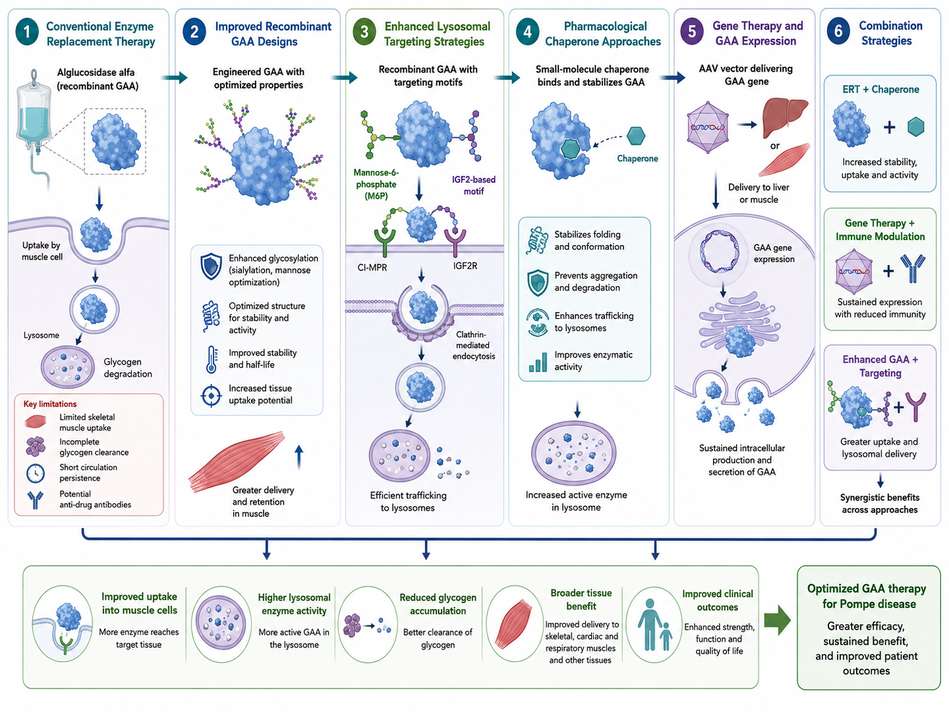
Figure 1: Evolution of GAA therapeutic strategies from conventional enzyme replacement to enhanced targeting, chaperone-assisted delivery, gene therapy, and combination approaches.
1. Current Role of Alglucosidase Alfa
Alglucosidase alfa is a recombinant human GAA designed to replace the deficient lysosomal enzyme in Pompe disease. Following intravenous administration, glycan structures containing mannose-6-phosphate (M6P) support interaction with the cation-independent M6P receptor (CI-MPR/IGF2R), cellular internalization, endosomal trafficking, and delivery to lysosomes. Once active in the acidic lysosomal environment, GAA hydrolyzes accumulated glycogen to glucose.
Its clinical and experimental importance extends beyond its therapeutic use. Alglucosidase alfa serves as a benchmark molecule for evaluating uptake, lysosomal processing, pharmacokinetics, immunogenicity, and tissue correction in emerging GAA programs. New candidates should therefore be compared with it using matched protein doses, molar activity, exposure, cell models, and disease-relevant functional endpoints.
| Benchmark Dimension | Role of Alglucosidase Alfa | Research Relevance |
|---|---|---|
| Enzyme replacement | Provides exogenous functional human GAA | Defines the reference ERT mechanism |
| Cellular delivery | Relies substantially on M6P receptor-mediated uptake | Provides a comparator for enhanced targeting designs |
| Functional endpoint | Supports lysosomal glycogen hydrolysis | Establishes glycogen clearance as a central readout |
| Development benchmark | Has extensive clinical and nonclinical experience | Supports translational study design and safety comparison |
2. Limitations of Conventional Enzyme Replacement Approaches
Systemically administered lysosomal enzymes must cross several biological barriers before reaching glycogen-filled lysosomes in skeletal and respiratory muscle. Circulating enzyme may be cleared by the liver or other tissues, while receptor abundance, receptor recycling, vascular access, endosomal escape from nonproductive routes, and autophagic disruption can all affect the amount of active GAA reaching target lysosomes.
| Limitation | Experimental Manifestation | Potential Consequence |
|---|---|---|
| Limited muscle uptake | Low intracellular GAA after matched extracellular exposure | Incomplete glycogen clearance in skeletal muscle |
| Short systemic persistence | Rapid decline in plasma enzyme concentration | Need for repeated intravenous dosing |
| Heterogeneous tissue delivery | Different activity recovery across liver, heart, diaphragm, and limb muscle | Uneven correction of disease pathology |
| Immune response | Anti-GAA antibodies, altered pharmacokinetics, or reduced uptake | Reduced or variable treatment response |
| Advanced cellular pathology | Persistent autophagic buildup and lysosomal damage | Enzyme exposure may not fully restore muscle function |
A higher administered dose is not equivalent to better lysosomal correction. Candidate evaluation should separate plasma exposure, cellular uptake, lysosomal localization, enzyme maturation, and glycogen clearance.
3. Improved Recombinant GAA Designs
Improved recombinant GAA molecules are engineered to overcome one or more limitations of first-generation ERT. Common approaches include increasing M6P content, modifying glycan presentation, improving conformational stability, extending circulating half-life, reducing aggregation, and optimizing the mature enzyme sequence or fusion architecture.
| Design Strategy | Intended Mechanism | Key Verification Assays |
|---|---|---|
| Higher M6P glycan density | Increase CI-MPR binding and cellular uptake | Receptor binding, M6P competition, uptake kinetics |
| Stability engineering | Reduce unfolding or loss of activity during circulation | Thermal stability, serum incubation, residual activity |
| Optimized glycosylation | Balance receptor targeting, clearance, and intracellular processing | Glycan profiling, PK, tissue biodistribution |
| Fusion or targeting domains | Engage alternative receptors or improve tissue penetration | Target binding, internalization, lysosomal co-localization |
| Sequence and process optimization | Improve expression, purity, and batch consistency | SEC-HPLC, activity assay, peptide mapping, potency testing |
4. Enhanced Lysosomal Targeting Strategies
Increasing productive lysosomal delivery is a central objective in next-generation GAA research. One route is to enrich accessible M6P glycans so that more enzyme binds CI-MPR on muscle cells. Other strategies use receptor-binding peptides, IGF2-derived motifs, antibodies, or tissue-targeting ligands to increase internalization through CI-MPR or alternative endocytic systems.
Targeting designs must be evaluated beyond initial surface binding. Strong receptor affinity can be unproductive if the complex does not dissociate in acidic endosomes, if the receptor is poorly recycled, or if the cargo is routed away from lysosomes. Productive targeting should result in increased mature lysosomal GAA, measurable intracellular activity, and sustained glycogen reduction.
| Targeting Level | Question | Recommended Readout |
|---|---|---|
| Receptor engagement | Does the candidate bind the intended receptor? | SPR/BLI, cell-surface binding, competition assay |
| Internalization | Is receptor-bound enzyme taken into cells? | Time-course imaging, flow cytometry, intracellular ELISA |
| Lysosomal delivery | Does internalized enzyme reach LAMP1/LAMP2-positive compartments? | Confocal co-localization, organelle fractionation |
| Functional correction | Does delivery restore enzyme function? | 4-MU activity and glycogen clearance assays |
5. Pharmacological Chaperone Approaches
Pharmacological chaperones are small molecules that stabilize a target protein or improve its folding, trafficking, or resistance to inactivation. In Pompe disease research, chaperones may be investigated in two distinct settings. Mutation-specific chaperones can support residual endogenous GAA variants that retain catalytic potential but are unstable or inefficiently transported. ERT-associated chaperones can bind administered recombinant enzyme, protect it during circulation, and improve delivery of active protein to tissues.
The key challenge is maintaining a favorable concentration window. A compound that stabilizes GAA at neutral pH may inhibit catalysis if it remains tightly bound after the enzyme reaches the lysosome. Studies should therefore compare enzyme stability, uptake, lysosomal dissociation, and glycogen hydrolysis across clinically or experimentally relevant concentration ranges.
| Chaperone Use | Potential Benefit | Main Risk |
|---|---|---|
| Residual mutant GAA stabilization | Improve folding and lysosomal trafficking of selected variants | Benefit may be strongly genotype dependent |
| Recombinant enzyme stabilization | Preserve active GAA during infusion and circulation | Excessive binding may inhibit lysosomal catalysis |
| Combination with targeting-enhanced ERT | Increase both stability and productive uptake | Complex exposure-response relationships |
6. Gene Therapy and GAA Expression
Gene therapy aims to convert selected tissues into a sustained source of functional GAA. Strategies include direct transduction of skeletal or respiratory muscle, liver-directed expression followed by secretion and cross-correction, hematopoietic stem cell approaches, and ex vivo gene-modified cell platforms. Vector systems under investigation include adeno-associated virus and lentiviral constructs, with promoter, codon, signal peptide, targeting tag, and immune profile all influencing performance.
Gene transfer changes the experimental framework from intermittent protein exposure to continuous or long-term expression. Studies should characterize vector biodistribution, GAA expression, secretion, tissue uptake, lysosomal processing, immune tolerance, durability, and dose-dependent toxicity. Supraphysiological expression should not automatically be interpreted as superior if enzyme is misprocessed or distributed to non-target tissues.
| Gene Therapy Strategy | Proposed Advantage | Major Research Question |
|---|---|---|
| Liver-directed secretion | Systemic cross-correction and possible immune tolerance | Is secreted GAA efficiently taken up by skeletal muscle? |
| Muscle-directed expression | Local production in highly affected tissue | Is transduction broad and durable across muscle groups? |
| Hematopoietic stem cell delivery | Long-term enzyme production from engrafted cells | Can sufficient enzyme reach muscle and nervous tissue? |
| Targeted or tagged GAA expression | Improve receptor-mediated cross-correction | Does the engineered product retain activity and safety? |
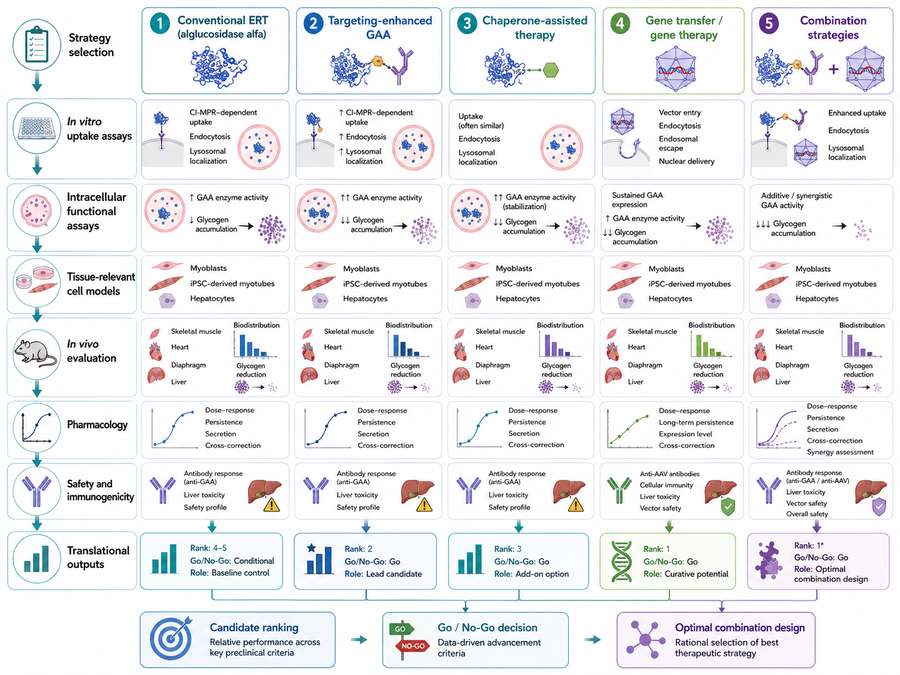
Figure 2: Preclinical comparison framework for conventional ERT, targeting-enhanced GAA, chaperone-assisted therapy, gene transfer, and combination strategies.
7. Combination Strategies
Pompe disease pathology involves enzyme deficiency, glycogen accumulation, lysosomal enlargement, autophagic disruption, muscle damage, and immune factors. A single intervention may not correct every component, particularly in advanced disease. Combination research therefore explores complementary mechanisms rather than simply combining agents with overlapping effects.
| Combination | Rationale | Suggested Study Design |
|---|---|---|
| ERT + pharmacological chaperone | Stabilize circulating enzyme and increase active tissue exposure | Factorial dose matrix with PK, uptake, and activity endpoints |
| Targeting-enhanced ERT + immune modulation | Improve delivery while reducing anti-drug responses | Repeated-dose immunogenicity and tissue correction study |
| Gene therapy + transient ERT | Provide early enzyme activity while transgene expression develops | Time-staggered treatment with durability follow-up |
| GAA restoration + autophagy modulation | Address substrate accumulation and secondary cellular pathology | Measure lysosomal function, autophagic flux, and muscle physiology |
8. Preclinical Evaluation Criteria
A robust preclinical program should connect molecular design to intracellular function and whole-organism outcomes. Enzyme activity measured in a purified system is necessary but insufficient. The candidate must remain stable, reach disease-relevant tissues, enter target cells, localize to lysosomes, undergo appropriate processing, reduce glycogen, and improve tissue physiology without unacceptable immune or off-target effects.
| Evaluation Tier | Core Measurements | Decision Question |
|---|---|---|
| Biochemical quality | Purity, aggregation, glycan profile, specific activity, stability | Is the candidate well characterized and assay-ready? |
| Cellular delivery | Receptor dependence, uptake rate, lysosomal localization, processing | Does exposure produce functional intracellular GAA? |
| Disease correction | Glycogen content, lysosomal size, autophagic markers, cell phenotype | Does the candidate correct Pompe-related pathology? |
| In vivo performance | PK, biodistribution, tissue activity, histology, muscle and respiratory function | Is correction broad, durable, and dose responsive? |
| Safety and immunity | Anti-drug antibodies, cytokines, organ toxicity, vector immunity | Is the benefit compatible with an acceptable safety profile? |
Compare next-generation candidates with recombinant acid alpha-glucosidase using both equal-mass and equal-activity conditions. This helps distinguish improvements in intrinsic potency from differences caused only by dosing.
9. Translational Challenges
Translation is complicated by the diversity of Pompe disease. Infantile- and late-onset disease differ in residual enzyme activity, organ involvement, immune risk, and treatment history. Within each group, genotype, age at intervention, baseline muscle damage, respiratory status, and prior ERT exposure can influence response. Animal models may reproduce glycogen storage but not fully capture human immune responses, muscle distribution, vector tropism, or long-term disease progression.
- Dose translation: protein or vector doses that correct mice may not scale directly to human muscle mass and receptor distribution.
- Biomarker interpretation: circulating markers can change without uniform correction of skeletal and respiratory muscle.
- Immunogenicity: pre-existing antibodies, CRIM status, capsid immunity, and immune tolerance can alter exposure and durability.
- Manufacturing: glycan consistency, vector potency, aggregation, and lot-to-lot comparability affect translational confidence.
- Long-term follow-up: sustained expression, delayed toxicity, and progressive muscle pathology require extended observation.
10. Future Outlook
The development trajectory of Pompe disease therapy is moving from systemic enzyme supply toward precise control of GAA stability, receptor engagement, tissue distribution, intracellular routing, and duration of expression. Future candidates may combine high-uptake enzyme designs with stabilizing partners, immune management, or gene-based production. The most successful strategies are likely to be those that deliver adequate active GAA to skeletal, respiratory, and cardiac tissues before irreversible pathology becomes established.
Research should remain mechanism-driven. Improvements in plasma exposure or total tissue protein must be linked to mature lysosomal enzyme, glycogen reduction, normalization of lysosomal and autophagic pathways, and recovery of muscle function. Acid alpha-glucosidase reagents, disease-relevant cellular models, and orthogonal analytical methods will remain central to comparing these increasingly complex therapeutic platforms.
Next-generation GAA therapy is not a single technology. It is a coordinated effort to improve enzyme quality, delivery, persistence, immune compatibility, and correction of downstream cellular pathology.
References
1. Kishnani, P. S., et al. (2007). Recombinant human acid alpha-glucosidase: major clinical benefits in infantile-onset Pompe disease. Neurology, 68(2): 99-109.
2. van der Ploeg, A. T., et al. (2010). A randomized study of alglucosidase alfa in late-onset Pompe disease. N Engl J Med, 362(15): 1396-1406.
3. Schoser, B., et al. (2021). Safety and efficacy of avalglucosidase alfa versus alglucosidase alfa in late-onset Pompe disease (COMET). Lancet Neurol, 20(12): 1012-1026.
4. Byrne, B. J., et al. (2017). Low-dose liver-targeted gene therapy for Pompe disease enhances therapeutic efficacy of ERT. Mol Ther Methods Clin Dev, 4: 59-67.
5. Parenti, G., et al. (2014). Pharmacological chaperone therapy for lysosomal storage diseases. Mol Ther, 22(3): 527-537.
6. Doerfler, P. A., et al. (2016). Copackaged AAV vector delivery of a bispecific biologic enables enhanced correction in Pompe disease models. Mol Ther, 24(5): 891-902.
7. Fuller, D. D., et al. (2013). The respiratory neuromuscular system in Pompe disease and response to gene therapy. Mol Ther, 21(8): 1481-1489.
8. de Faria, D. O. S., et al. (2024). Emerging and next-generation therapies for Pompe disease. J Neuromuscul Dis, 11: 1-20.
9. U.S. Food and Drug Administration. LUMIZYME (alglucosidase alfa) prescribing information.
10. U.S. Food and Drug Administration. NEXVIAZYME (avalglucosidase alfa-ngpt) prescribing information.