
Assay Development: Validating IVIg Batches for HAMA Interference in Sandwich ELISA
Eliminating ELISA Interference: Validating IVIg Batch-to-Batch HAMA (Human Anti-Mouse Antibodies) Effects
Abstract
Human plasma-derived intravenous immunoglobulin (IVIg) products may contain naturally occurring anti-animal antibodies that compromise assay integrity. This technical guide outlines a systematic approach for qualifying IVIg batches in sandwich ELISA development, focusing on HAMA interference validation and mitigation strategies. By implementing blank ELISA testing with heterophilic antibody blockers, background signals can be reduced by 80-95%, ensuring reliable detection of therapeutic proteins in immunoglobulin-based therapies.
HAMA interference, ELISA background reduction, IVIg quality control, heterophilic antibody blocking
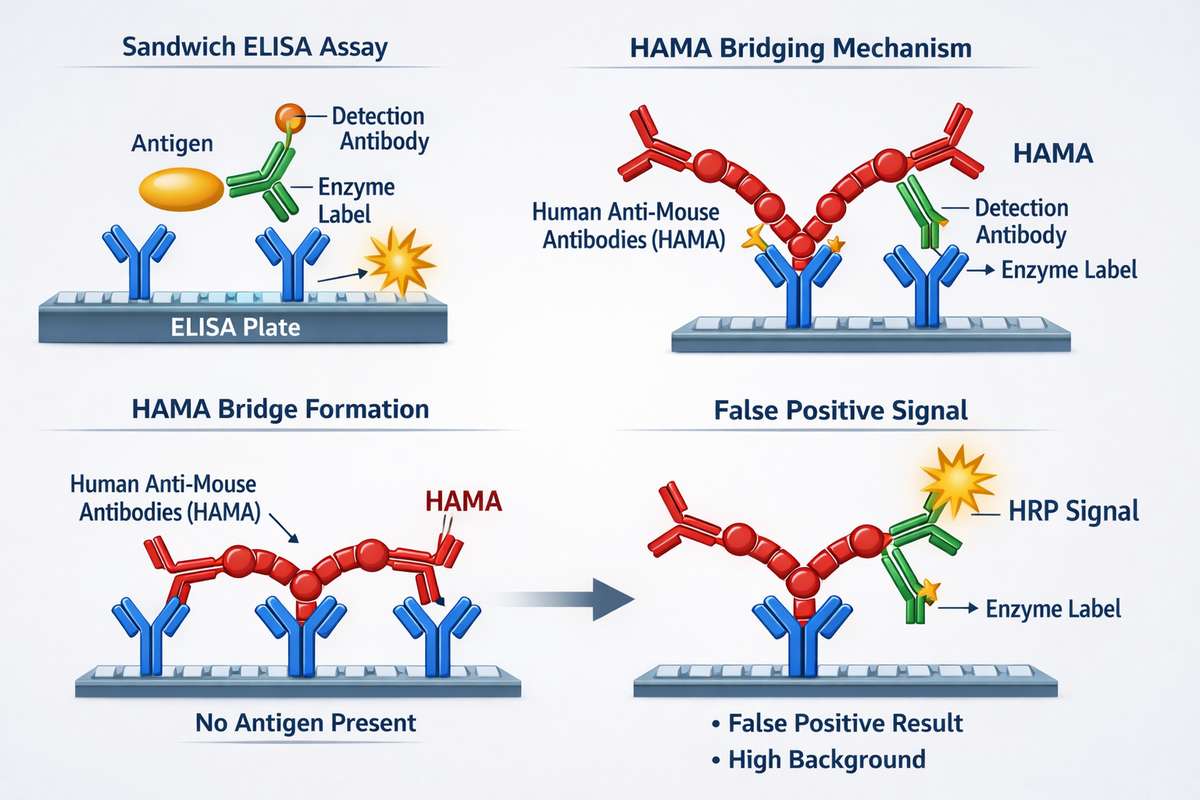
Fig1. HAMA bridging mechanism causing false-positive signals in sandwich ELISA
1. Background: Endogenous Anti-Animal Antibodies in Plasma-Derived Products
Human plasma-derived intravenous immunoglobulin (IVIg) products contain a heterogeneous mixture of antibodies, including naturally occurring anti-animal antibodies such as Human Anti-Mouse Antibodies (HAMA) and other heterophilic antibodies. In sandwich ELISA configurations, these endogenous antibodies can bridge capture and detection antibodies—both typically of murine origin—generating false-positive signals that significantly elevate background noise. This interference is particularly problematic when detecting low-concentration analytes in IVIg-containing samples, where signal-to-noise ratios are critical for accurate quantification.
HAMA bridging can produce false-positive signals up to 3-5× above baseline background in untreated IVIg samples, directly impacting the limit of detection (LOD) and lower limit of quantification (LLOQ) of therapeutic protein assays.
2. Test Protocol: Blank ELISA Method for HAMA Assessment
2.1 Experimental Design
The blank ELISA method evaluates IVIg samples in the absence of target analyte to isolate HAMA-specific interference:
| Group | Sample Type | Blocking Agent | Purpose |
|---|---|---|---|
| A | Buffer blank (PBS-T) | None | Baseline background determination |
| B | IVIg Lots 1–3 (1–10 mg/mL) | None | HAMA interference assessment |
| C | IVIg Lots 1–3 | Mouse IgG (10 μg/mL) | Passive blocking evaluation |
| D | IVIg Lots 1–3 | HAMA Blocker (HBR, 1:100) | Active blocking validation |
| E | HAMA-positive control | ± Blocking agents | Positive control verification |
2.2 Detailed Procedure
Step 1: Plate Coating and Sample Application
- Coat microplate with murine capture antibody (5 μg/mL) overnight at 4°C
- Block with 1% BSA in PBS-T for 1 hour at room temperature
- Apply IVIg test samples at three concentrations: 1, 5, and 10 mg/mL
- Critical Control: Omit target analyte standards to simulate true "blank" conditions
Step 2: Heterophilic Antibody Blocking
- Passive Blocking: Supplement sample diluent with mouse IgG (10 μg/mL) to saturate Fc receptors
- Active Blocking: Add commercial HAMA blocker (e.g., Scantibodies HBR) at manufacturer-recommended concentration (typically 1:100)
- Incubate samples with blockers for 30 minutes at room temperature before adding detection antibody
Step 3: Detection and Signal Amplification
- Add HRP-conjugated murine detection antibody (1:10,000 dilution)
- Incubate 1 hour at room temperature
- Develop with TMB substrate for 10 minutes; stop with 2N H₂SO₄
- Read optical density (OD) at 450 nm (reference 630 nm)
3. Results Interpretation: Threshold Setting and Residual Interference Mitigation
3.1 Acceptance Criteria
Establish quantitative thresholds based on signal-to-noise (S/N) ratios:
| Classification | OD (450 nm) | S/N Ratio | Interpretation |
|---|---|---|---|
| Negative | ≤0.10 | ≤2.0 | No significant HAMA interference |
| Equivocal | 0.11–0.20 | 2.1–3.0 | Borderline interference; requires blocking |
| Positive | >0.20 | >3.0 | Significant HAMA; batch unsuitable without mitigation |
3.2 Data Analysis Flow
- Tier 1: Unblocked Interference Assessment
- If Group B (unblocked IVIg) OD >0.20, confirm HAMA presence
- Calculate %CV across three IVIg lots; acceptance criteria: CV <15%
- Tier 2: Passive Blocking Efficiency
- If Group C OD decreases by >50% vs. Group B, indicates low-affinity HAMA
- Residual OD >0.10 suggests requirement for stronger blocking
- Tier 3: Active Blocking Validation
- Group D must achieve OD ≤0.10 at all test concentrations for batch qualification
- If residual signal persists, consider combined blocking strategy (mouse IgG + HBR)
Qualified IVIg Batch: Demonstrates OD ≤0.10 and S/N ≤2.0 across all tested concentrations (1–10 mg/mL) when active blocking agent is applied. Batches failing this criterion should be rejected or restricted to non-ELISA applications.
4. Troubleshooting and Optimization Strategies
4.1 When Blocking Is Ineffective
Sample Dilution:
- Increase IVIg dilution from 1:10 to 1:100 to reduce antibody concentration while maintaining detectable analyte levels
Enhanced Blocking:
- Extend blocker incubation to 60 minutes for improved saturation
- Use combined blocking: mouse IgG (10 μg/mL) + HBR (1:200) for synergistic effect
- Switch to alternative blockers: murine serum (5% v/v) or commercial heterophilic blocking tubes
Assay Reformatting:
- Consider converting to non-murine systems (e.g., rabbit/goat antibodies) or alternative platforms (Meso Scale Discovery, Gyrolab) less susceptible to HAMA interference
4.2 Quality Control Requirements
- Incoming Material Testing: Qualify each IVIg lot upon receipt using the blank ELISA protocol before use in critical assays
- Reference Standards: Include HAMA-positive and -negative controls in every analytical run to monitor blocker performance
- Longitudinal Tracking: Maintain a historical database of HAMA levels across manufacturers and lot numbers to inform procurement decisions
5. Conclusion: Standardized HAMA Validation for Therapeutic Protein Assays
HAMA interference represents a critical variable in bioanalytical assays involving plasma-derived products. This protocol provides a standardized framework for qualifying IVIg batches, ensuring batch-to-batch consistency and minimizing the risk of false-positive results. By implementing rigorous blank testing and optimized blocking strategies, laboratories can achieve robust, reproducible data for IVIg-related therapeutic development programs.
Incorporate this HAMA validation protocol into your standard operating procedures for all sandwich ELISA methods utilizing IVIg matrices. Document all qualification data and establish a cross-functional review process between analytical development and quality control teams to ensure scientific rigor and regulatory compliance.
References
1. Kaplan IV, Levinson SS. When is a heterophile antibody not a heterophile antibody? When it is an HAMA. Clin Chem. 1999;45(5):616-618.
2. Kricka LJ. Human anti-animal antibody interferences in immunological assays. Clin Chem. 1999;45(7):942-956.
3. Bolstad N, Warren DJ, Nustad K. Heterophilic antibody interference in immunometric assays. Best Pract Res Clin Endocrinol Metab. 2013;27(5):663-675.